Interviews & Reviews
Venice labyrinth has some churchgoers balking at circles
By Martha Groves, Los Angeles Times
May 4, 2010 12 AM PT
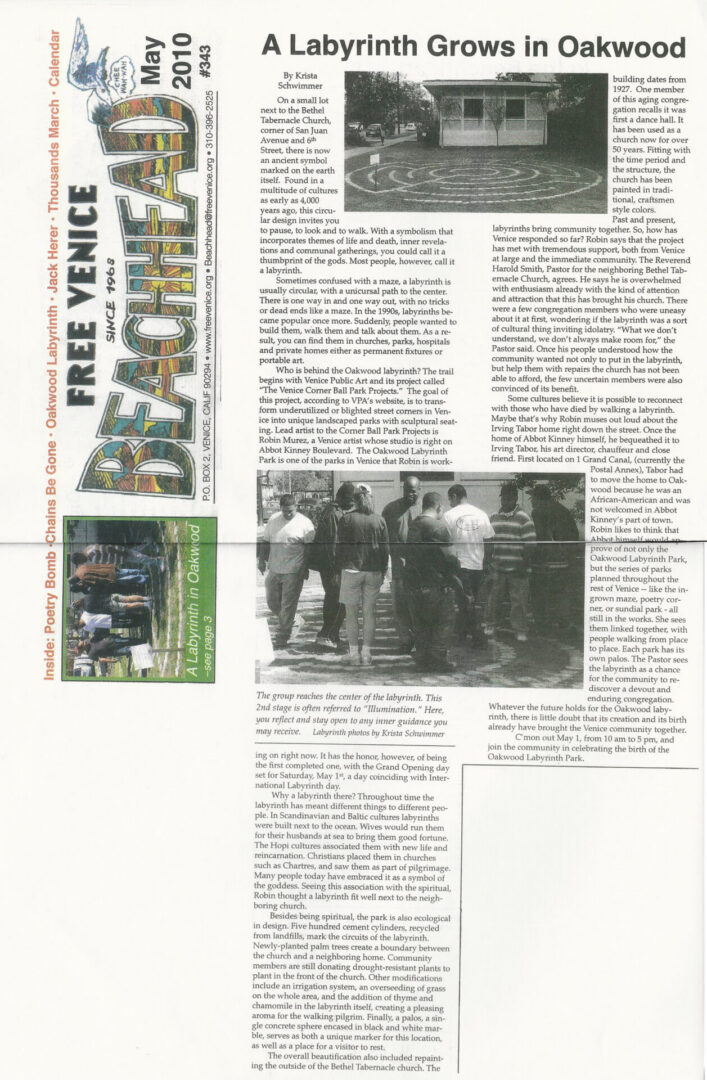
With its burned-out lawn and overgrown bushes, the corner lot next to Bethel Tabernacle Church in Venice struck sculptor Robin Murez as ripe for resurrection.
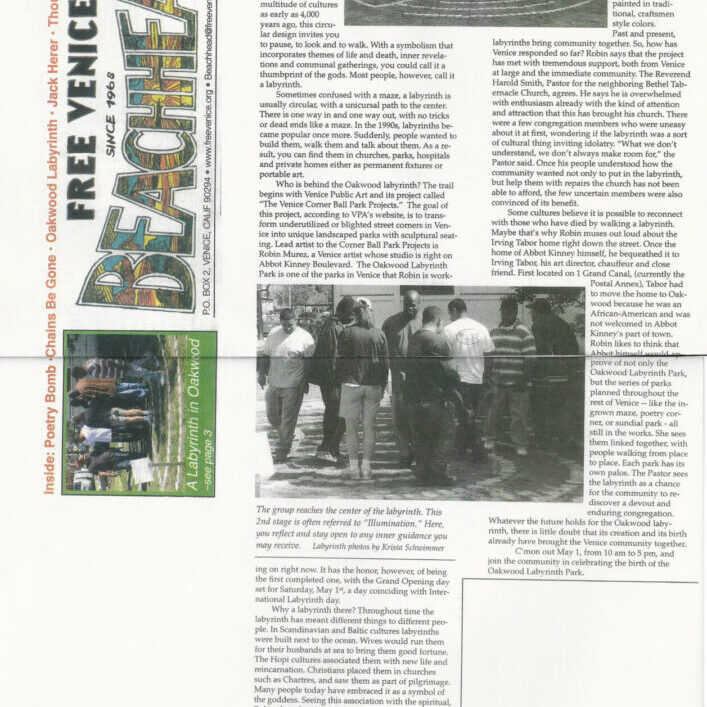
So Murez laid plans to turn the church-owned lot into a pocket park with an in-ground labyrinth, where neighbors could gather to chat, and aging churchgoers could park cars there during suppers and Bible study.
“A labyrinth is a very serene place made for spiritual meditation,” Murez said. “The neighborhood needs some healing. The site looked like a scar.”
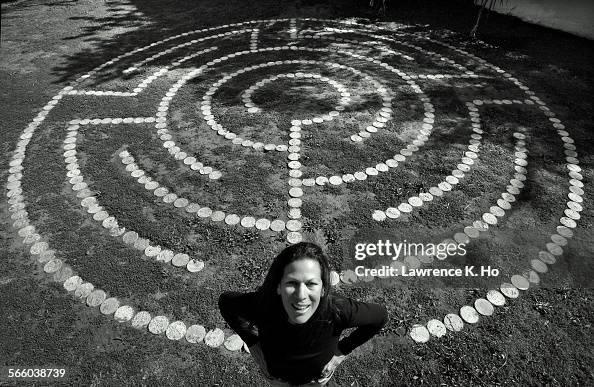
After months of plotting and planting, the Oakwood Labyrinth at 6th and San Juan avenues was officially unveiled on Saturday — World Labyrinth Day.
Volunteers worked to build the decorative maze with concrete core samples, each of which was 12 inches tall and 6 inches in diameter and buried flush with the turf. Having personally invested hundreds of unpaid hours and thousands of dollars’ worth of materials, Murez speaks of the project with a mixture of exhaustion and pride.
But the lawyer-turned-artist has learned something about the community she thought she knew so well: Even if one’s aim is to improve an area that needs improving, not everyone will be thrilled with the results.
Although passers-by and many neighbors are delighted by the change, the dozen or so elderly churchgoers (oldest member: 94) remain divided on the merits.
“My neighbors told me it was a pagan-type thing,” said Carol Powell, a member who lives a few blocks from the church. “My concern is you don’t walk in a circle. You come inside the church to worship.”
In a neighborhood that has long struggled with gentrification, where million-dollar homes and quirky architectural wonders rise beside peeling bungalows, Murez’s offers of help met with some suspicion.
Pastor Harold G. Smith, who said he feels OK about the labyrinth, said some people have had “some problems with understanding its significance. But I need to help them understand that even if you don’t necessarily like it, you do need to appreciate people doing good things for you for free.”
Murez first broached the labyrinth idea last summer with Sammie Moore, or “Mother Moore,” as Bethel’s members call her. Moore was cleaning the church one Saturday when Murez cycled by.
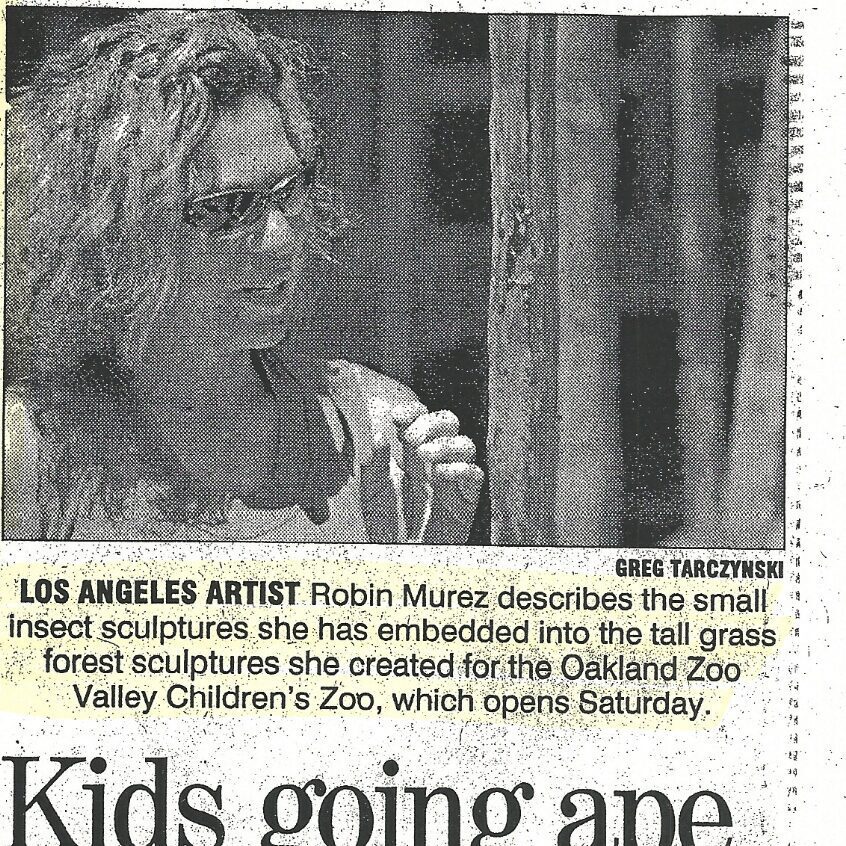
Murez, who has long maintained a studio and outdoor sculpture garden on Abbot Kinney Boulevard, told Moore about her desire to create public green spaces.
“Robin has a special spirit,” Moore said, “and I was drawn to the idea.”
Moore and Smith said they have done their best to explain to the congregation the concept of a labyrinth as a path for personal, psychological and spiritual transformation. After all, one of the most famous prayer labyrinths, dating from about 1200, is embedded in the floor at Chartres Cathedral near Paris.
But Smith acknowledged that some church members remain confused. Since the labyrinth’s recent completion, he said, feedback has been “nil, zero, zilch.” Meanwhile, church member Powell said she was upset to learn recently that dancing would be part of the opening festivities.
The church got more than it expected out of the arrangement. A block away sits the green Craftsmanstyle house that Venice developer Abbot Kinney bequeathed to his African American chauffeur, Irving Tabor. With that for inspiration, Murez and volunteers painted the beige Craftsman-style church in several complementary shades of green.
Local plumbers, nurseries and stores provided laborers and pitched in with paint, queen palms and an automated sprinkler system.
Alyson Horn, who lives across the street, said the labyrinth “creates a feeling of community and …actually ends up making the area safer. It changes the energy.”
Next door, sculptor Woods Davy initially raised a fuss when landscape architects urged Murez to remove a tree that provided a privacy screen. Murez trimmed it instead, and Davy now says the freshly painted church is “absolutely beautiful.”
Martha Groves who covered the Westside for the Los Angeles Times, left the newsroom in 2015. A native Hoosier, she became a Metro reporter after many years as a Business writer and editor. She previously worked for the Philadelphia Inquirer and the late, lamented Chicago Daily News.

By The Argonaut Apr 14, 2009
CORNER BALL PARK GROUP — Community members including Betsy Goldman, Adam Davis, Stephen Pouliot, Todd von Hoffmann, Nadine Parkos, Antonio Martinez, Phoebe Zimmermann, D. Rufus SavageFriedman, Finnegan Wong-Smith, Wilma Wong, Hedwin Naimark, Robin Murez, Denise Ruttman and Robert Naimark are getting involved in an effort to transform underutilized Venice street corners into green spaces. (Argonaut photo by T.W. Brown)
By The Argonaut
Sculptor and community groups work to transform public spaces to symbolize Venice’s eclectic unity
BY VINCE ECHAVARIA
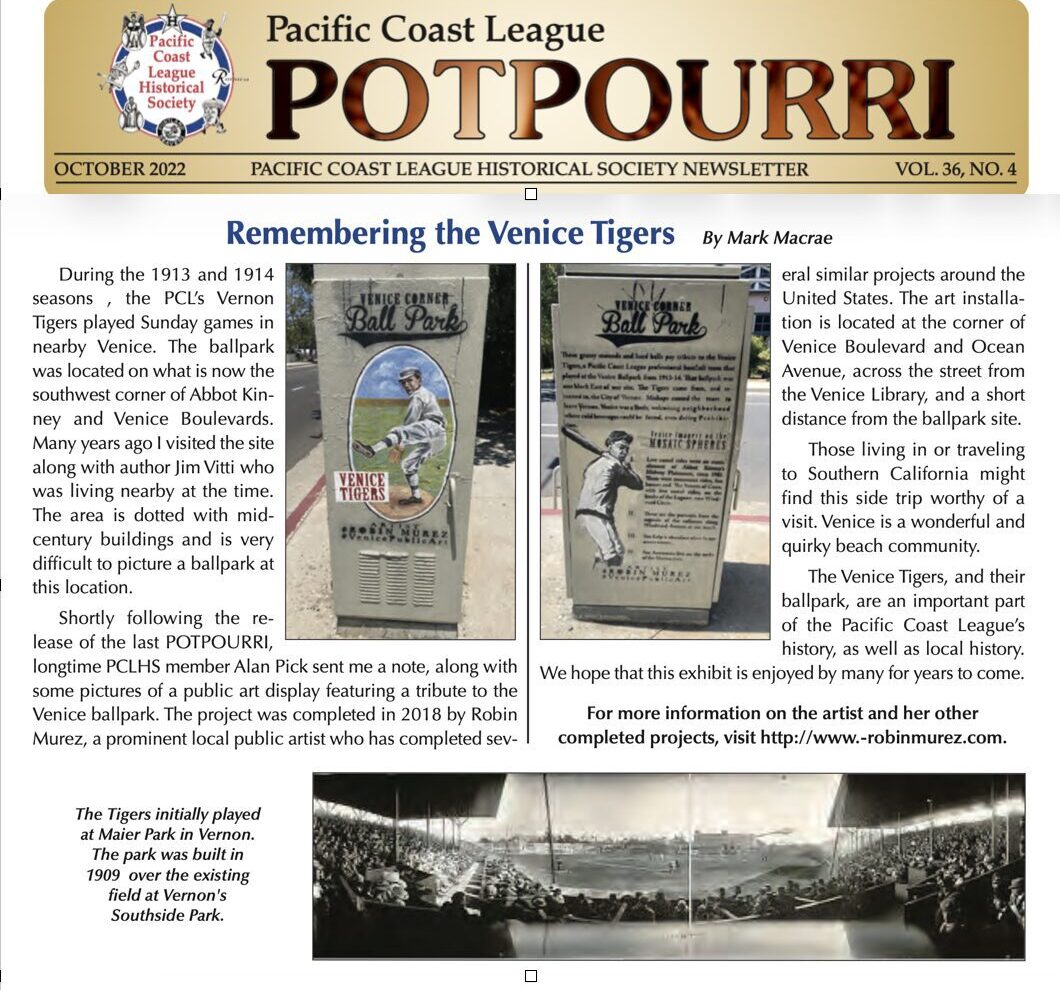
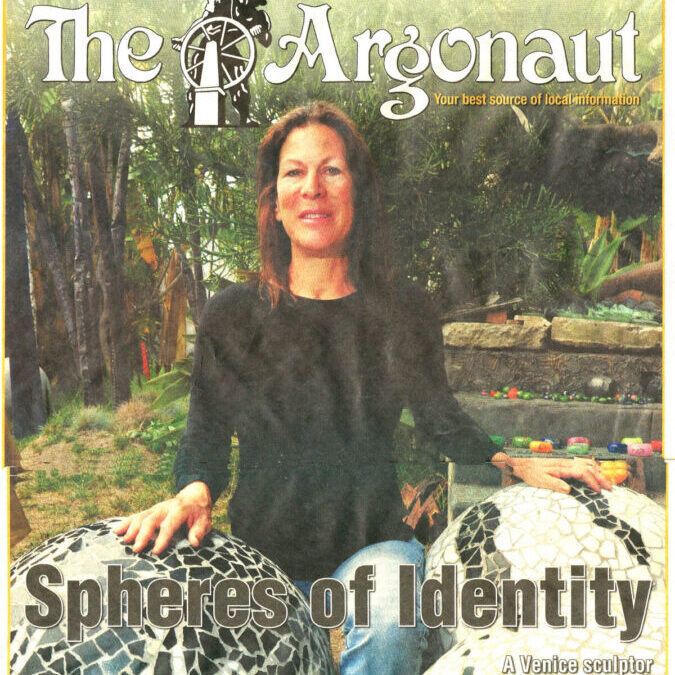
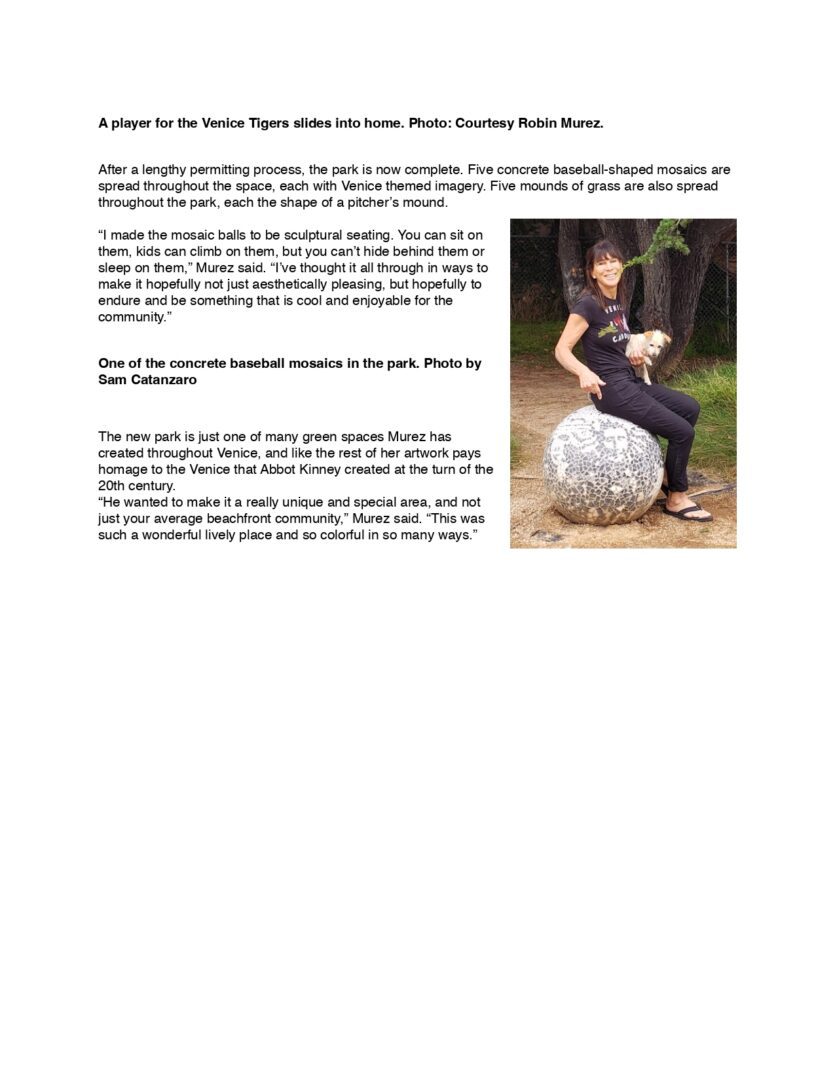
Formed around concrete sphere sculptures, the mosaic images depict symbols of faces, triangles, sea creatures and sea plants.
While the images may not seem to have an obvious connection, the artist who created the spherical sculptures says they can represent aspects of life in the beachside community of Venice.
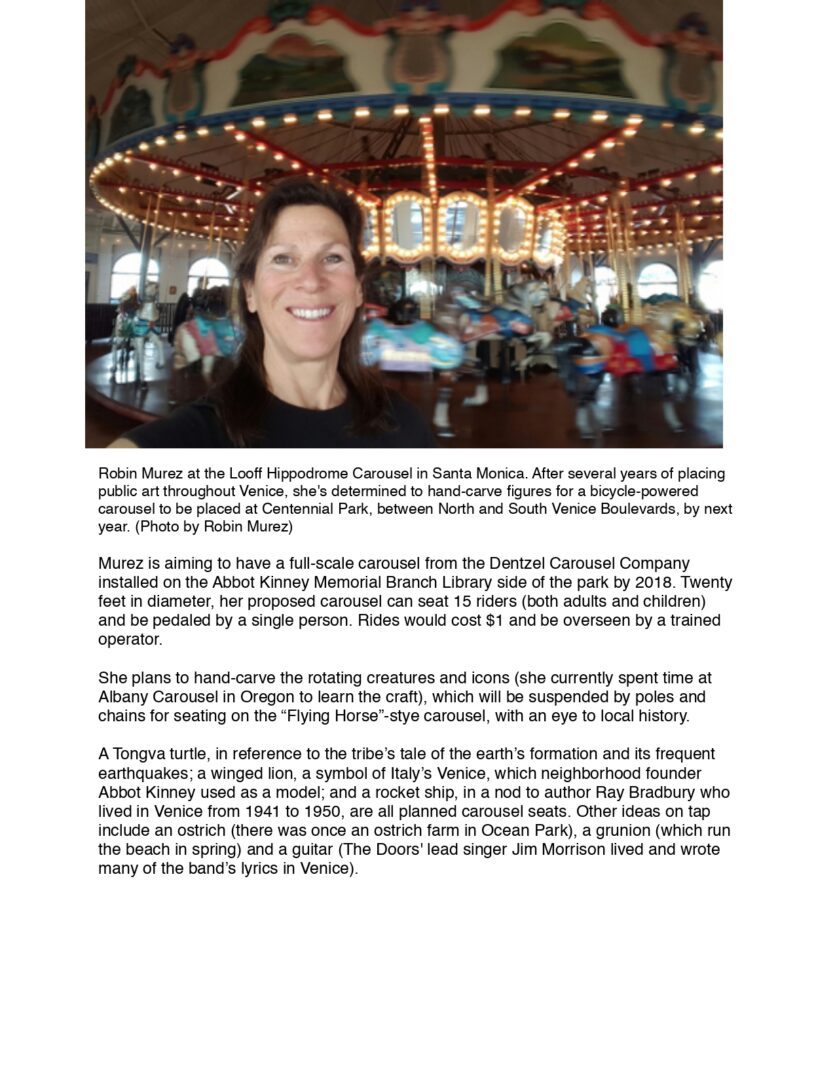
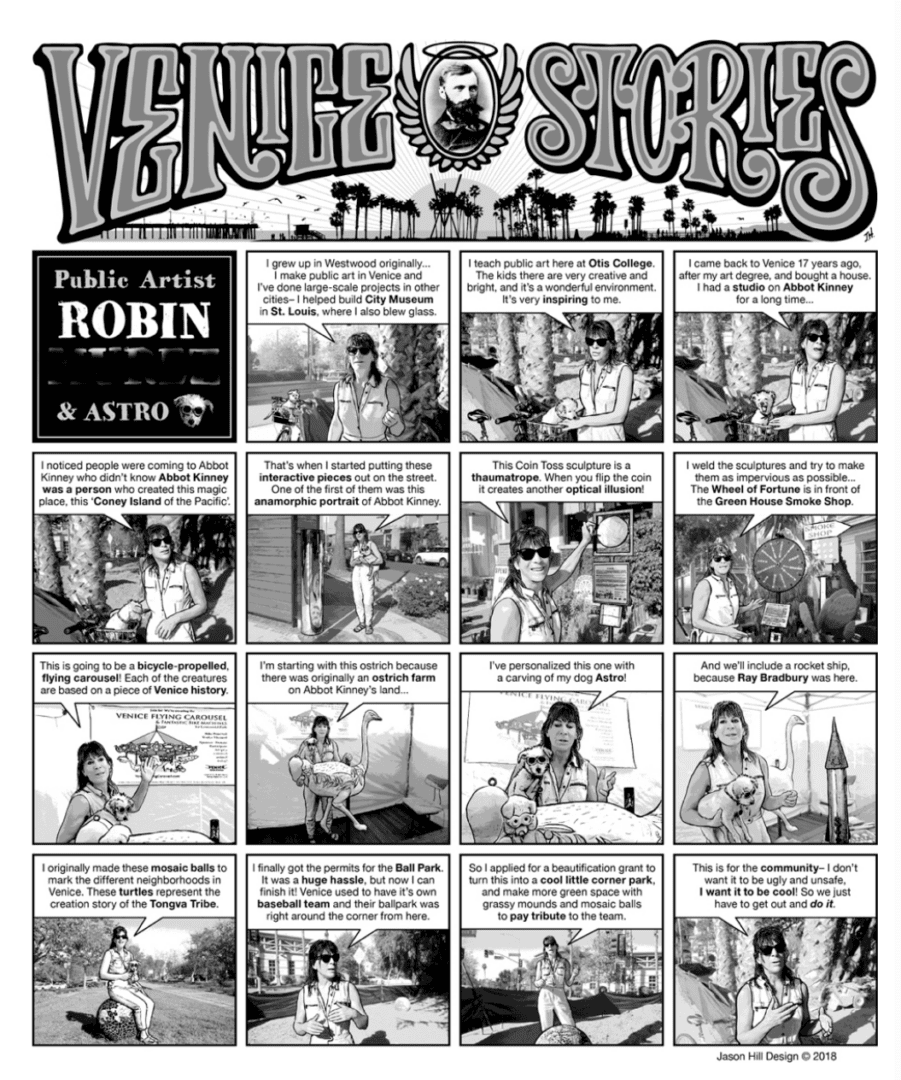
Describing her latest work at her open-air studio on Abbot Kinney Boulevard, Venice sculptor Robin Murez explains that her art is about transforming public spaces to make the viewer feel more connected to the work. Through her mosaic spheres, which she calls palas based on the Italian word for ball, Murez says she intends to portray images associated with Venice.
The symbols of triangles are representative of the neighborhood along Venice Boulevard known as the Silver Triangle, the facial images of the Colonnade structure symbolize historic Venetian architecture, while the images of sea life can show the community’s connection to the beach. Such examples are about eclectic unity and are ways that viewers can identify with specific areas of Venice through art, Murez said.
We like to think of Venice as being its own community, she says. We pride ourselves on being individuals and being creative.
Murez, a former attorney who has lived in Venice about 20 years, says each of the black and white mosaic sculptures takes approximately 40 hours to finish.
She is currently working on completing the first set of five sphere sculptures to be incorporated as part of a park project at a former enclosed lot on Venice Boulevard at Ocean Way. The city-owned lot between the Venice Library and Kim’s Market was awarded a $10,000 Los Angeles beautification grant last year to be transformed into a pocket park, and Murez said a community plan is under way to place her sphere sculptures there for seating, along with an in-ground maze and landscaping.
The Corner Ball Park Project involves several community groups and is part of an effort to transform underutilized or blighted street corners throughout Venice into neighborhood green spaces fit with landscaping and sculptural seating. The project was unanimously supported by the Venice Neighborhood Council at its meeting in March.
The first project is planned at the formerly enclosed lot on Venice Boulevard, and community members hope to expand the effort to other neighborhoods, allowing each area to convey its own identity through the art project.
It’s a way of creating neighborhood pride, Murez said of the project.
Neighbors can work together to represent their areas through the projects and in doing so, they can get to know each other better, Murez said. The residents may decide to create neighborhood logos to display at cultural events and apply symbols specific to their area on the park pala sculptures, which can enhance neighborhood identity, Murez said.
It’s based on an historic tradition, a way to get to know our neighbors, to enjoy the eclectic unity of our community, and to form neighborhood identities, enabling Venice festivities, Murez said. The ball parks will make Venice more walkable and more beautifully green, one little pocket park at a time.
Among the community organizations involved in the effort are the Venice Action Committee, the Venice Public Art forum and Venice 2000, which plans to help with park landscaping.
Murez estimates that each corner ball park will need about $5,000 to $10,000 in funding to be completed. Those working with the projects are encouraging community members to take part by finding potential sites for the parks, helping to raise funds and creating park designs that are unique to the neighborhood.
Residents associated with the project praised the effort for helping to boost neighborhood pride in a community with a rich arts background.
I think this is a great opportunity for awareness on several levels, said Stephen Pouliot, a member of the Venice Heritage Foundation. It will be fascinating to go neighborhood to neighborhood and see iconic pieces of sculpture.
Adam Davis, an architect who lives in the neighborhood where the first project is planned, sees the parks providing a common thread to stitching all the neighborhoods together.
Venice Heritage Foundation president Todd von Hoffmann called the project completely appropriate. It will make a spectacular addition to our public art, he said.
https://www.argonautnews.com/news/news-features/sculptor-and-community-groups-work-to-transformpublic-spaces-to/article_e6521823-042a-574f-b442-1a9773d52878.html
OPINION SEPTEMBER 21, 2017
Venice Flying Carousel
by MELANIE CAMP
by Akela Morinaka
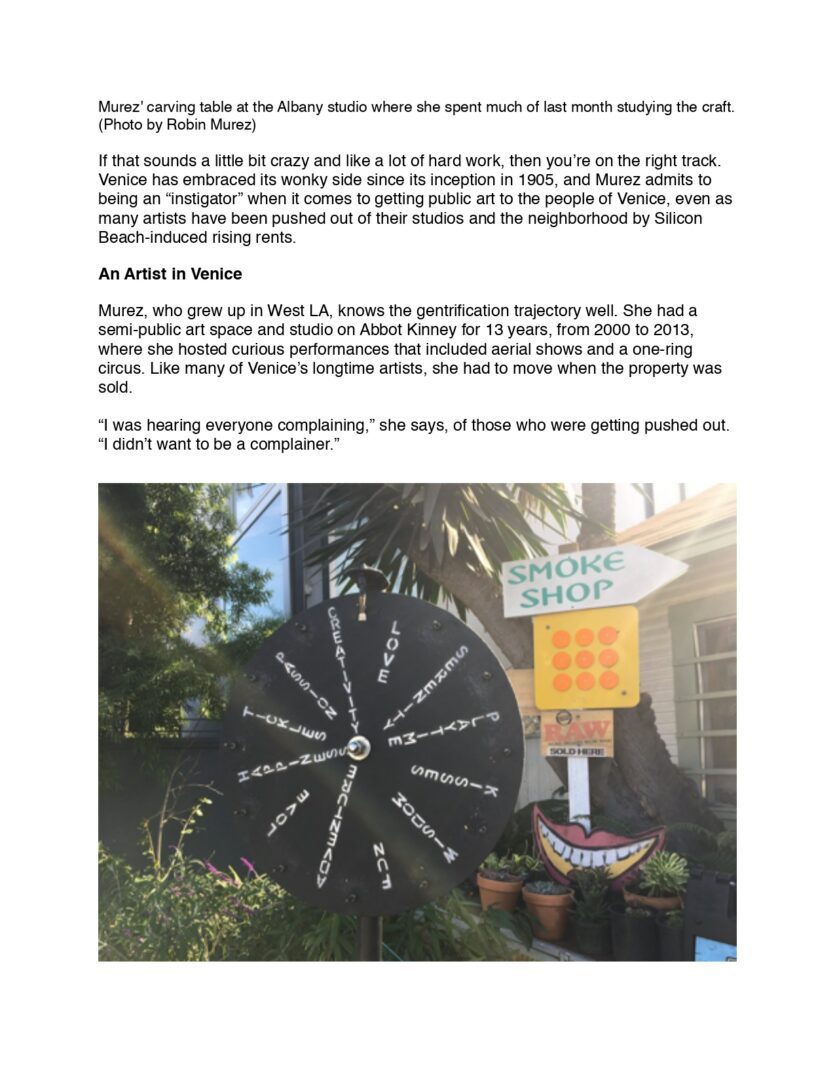
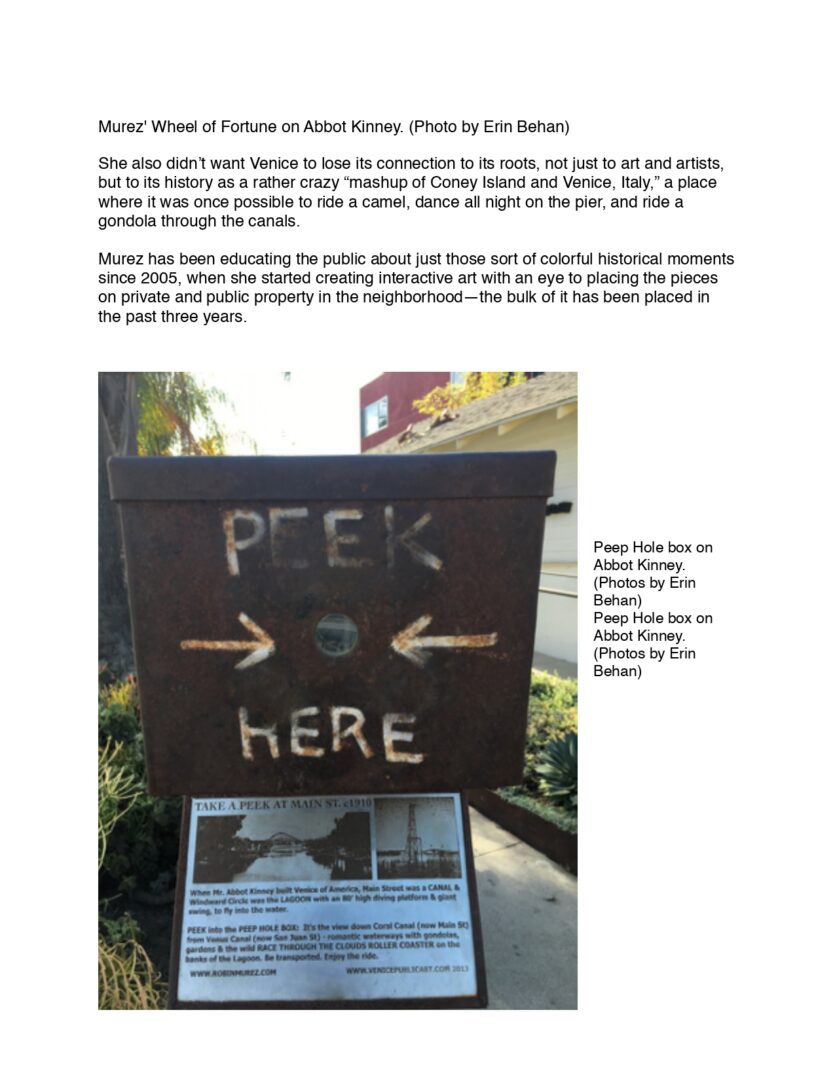
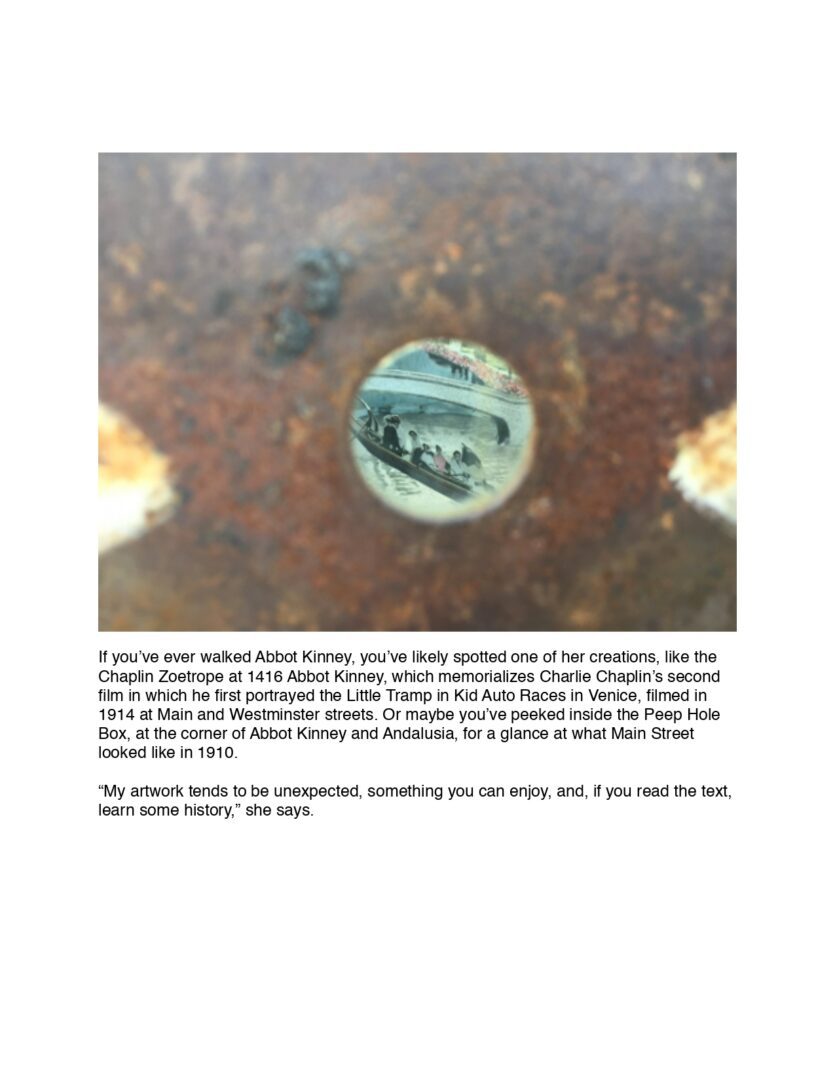
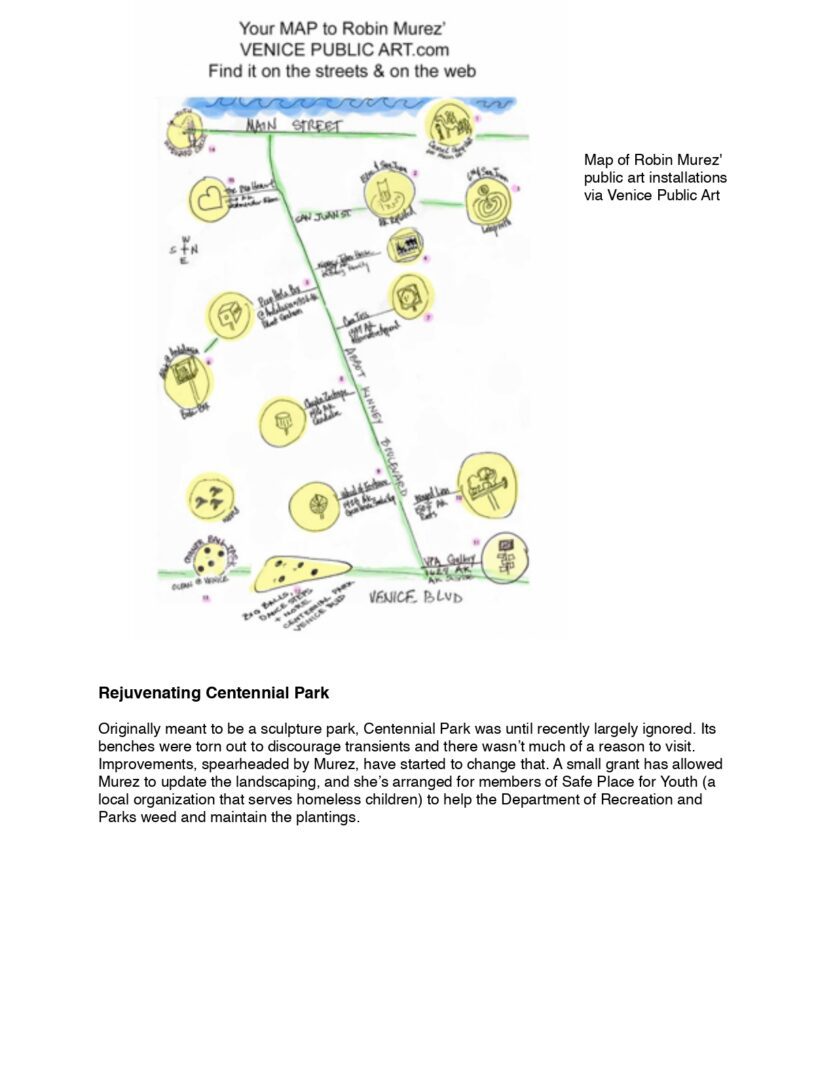
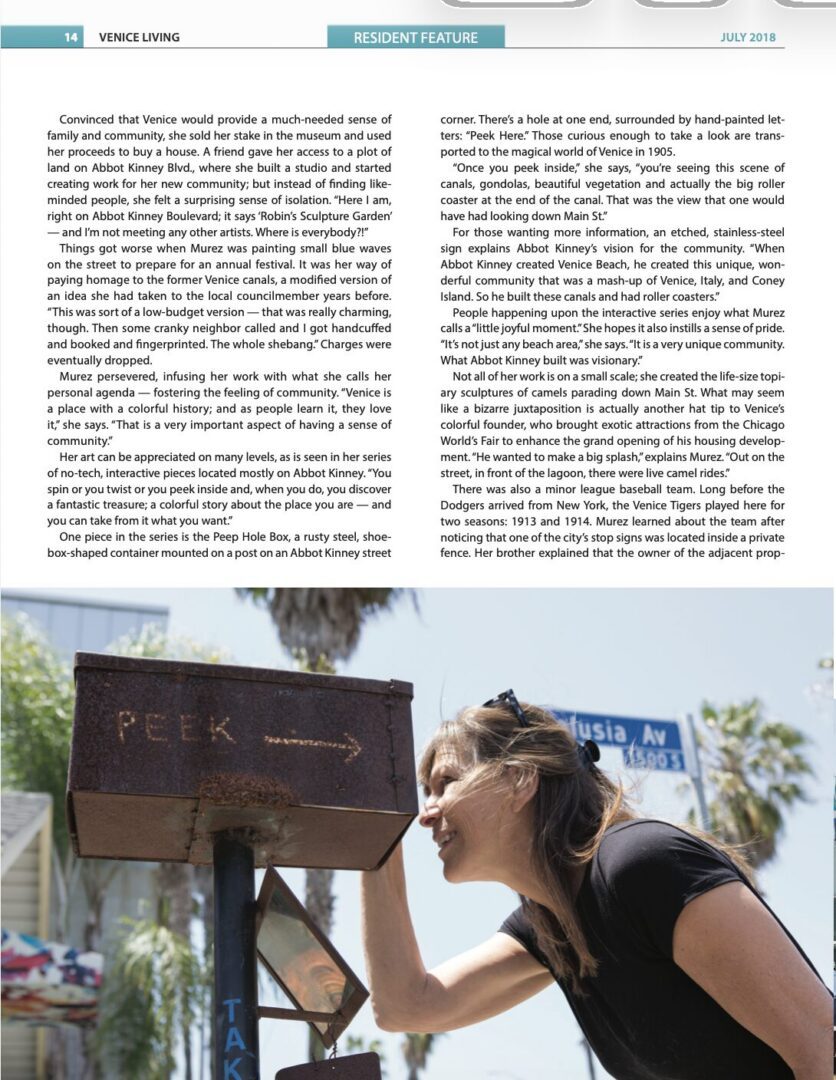
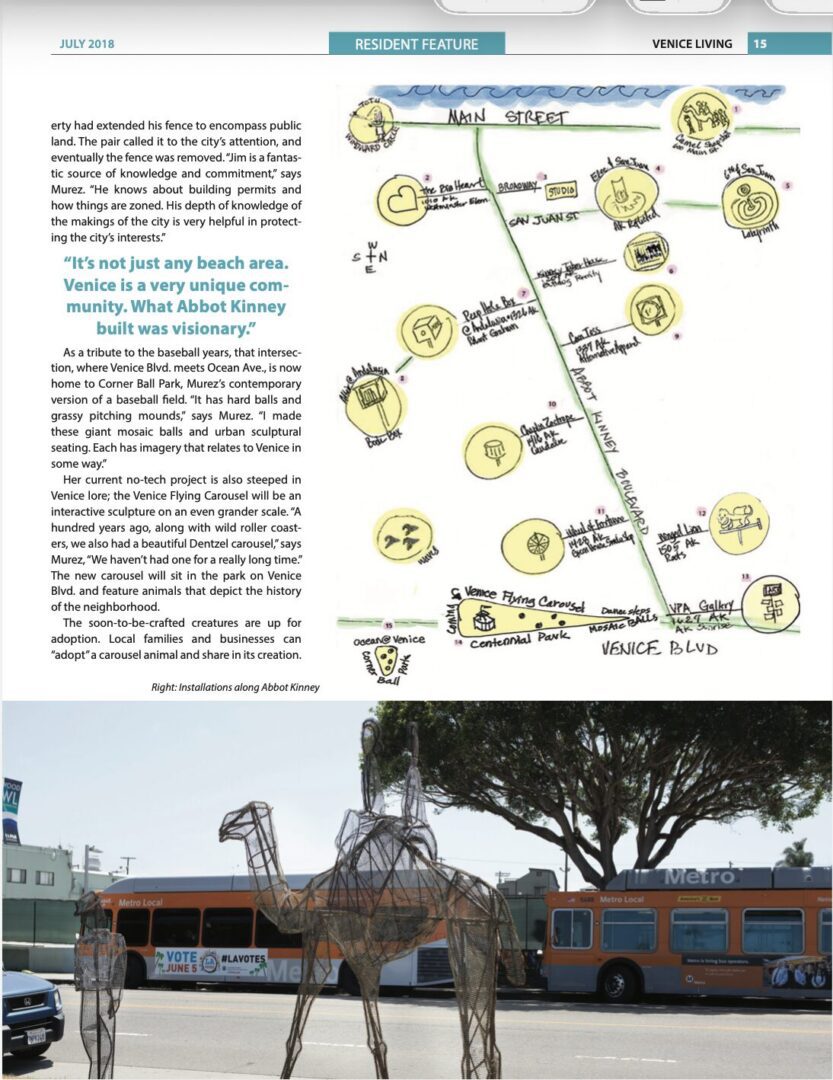
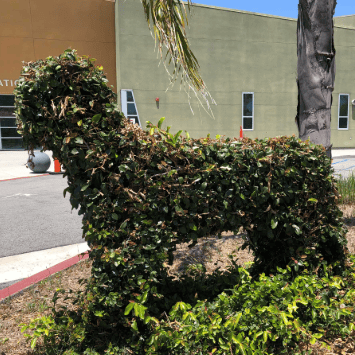
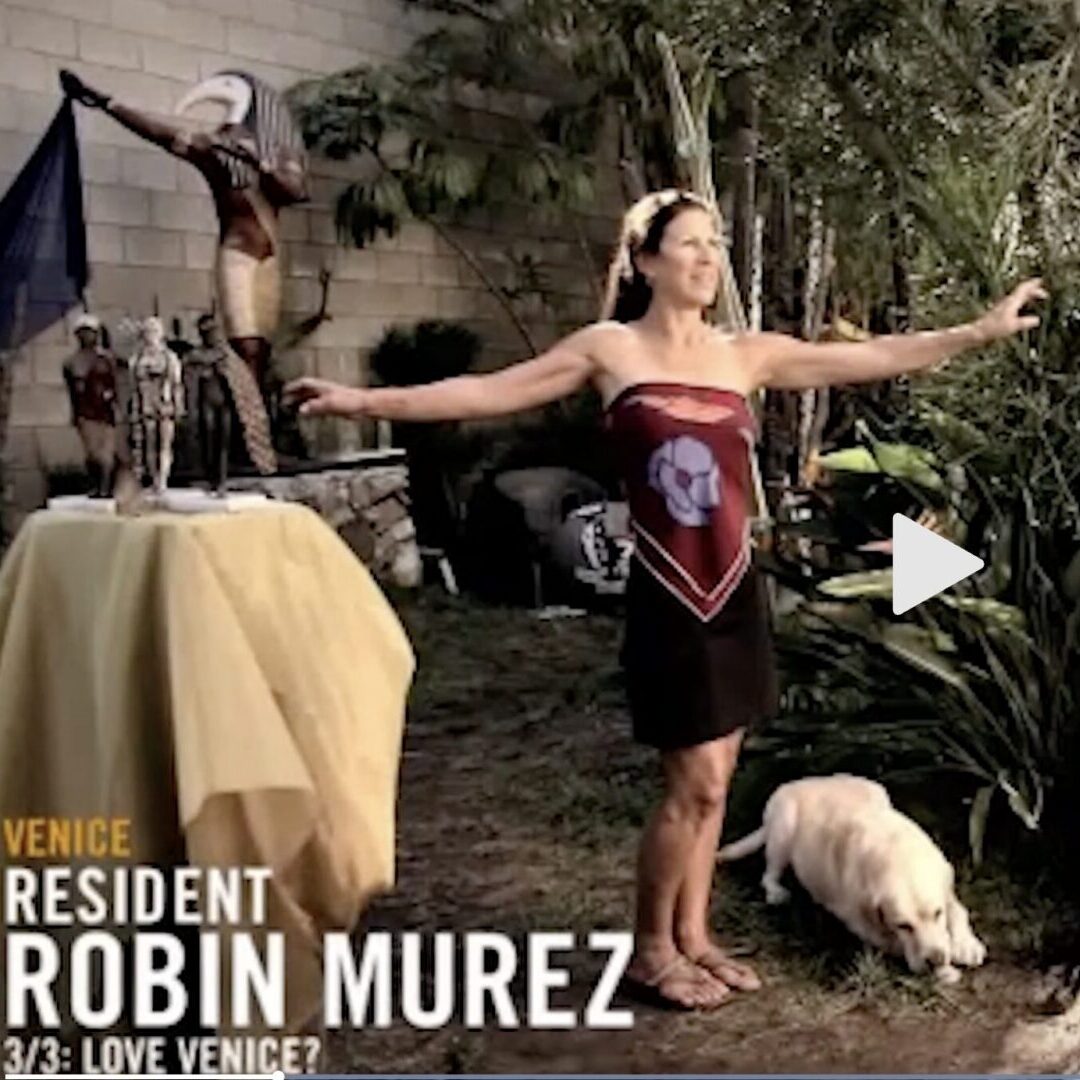
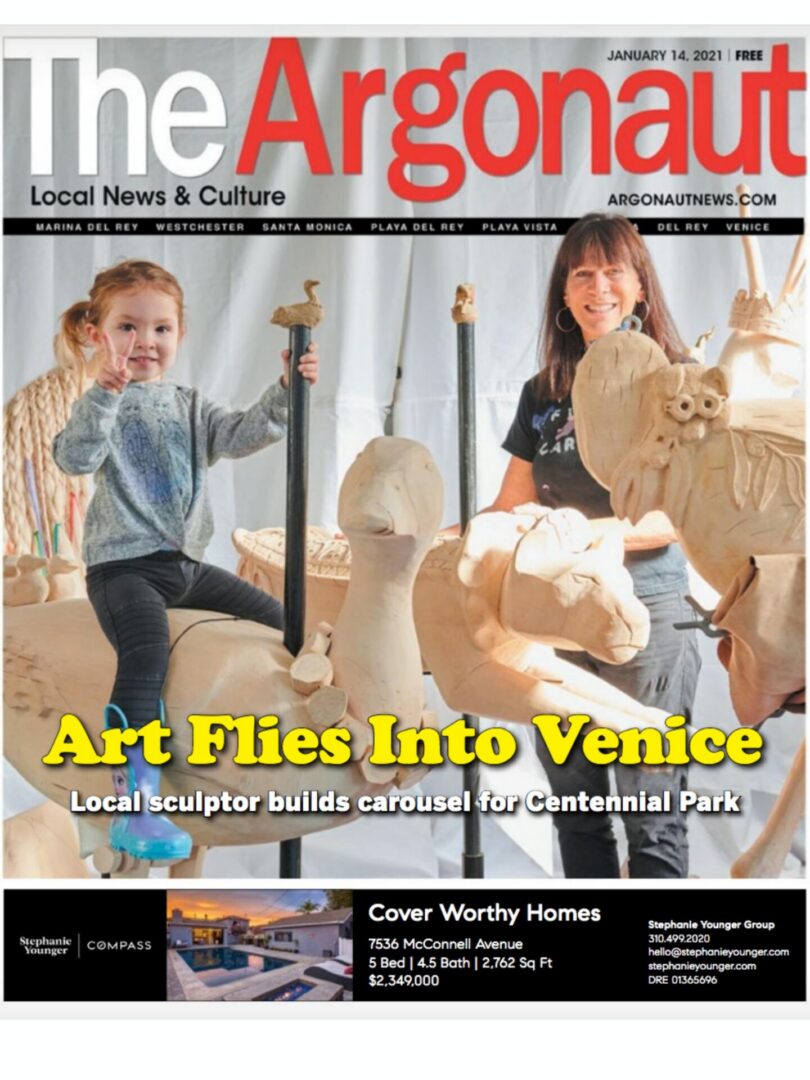
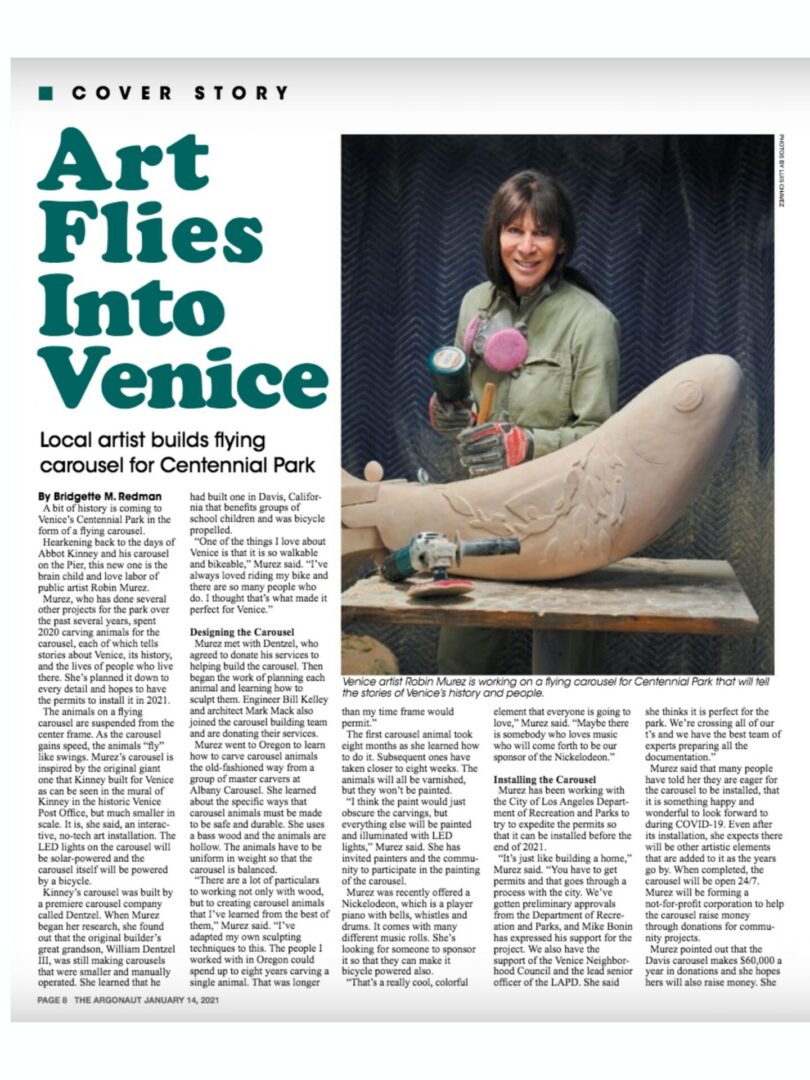
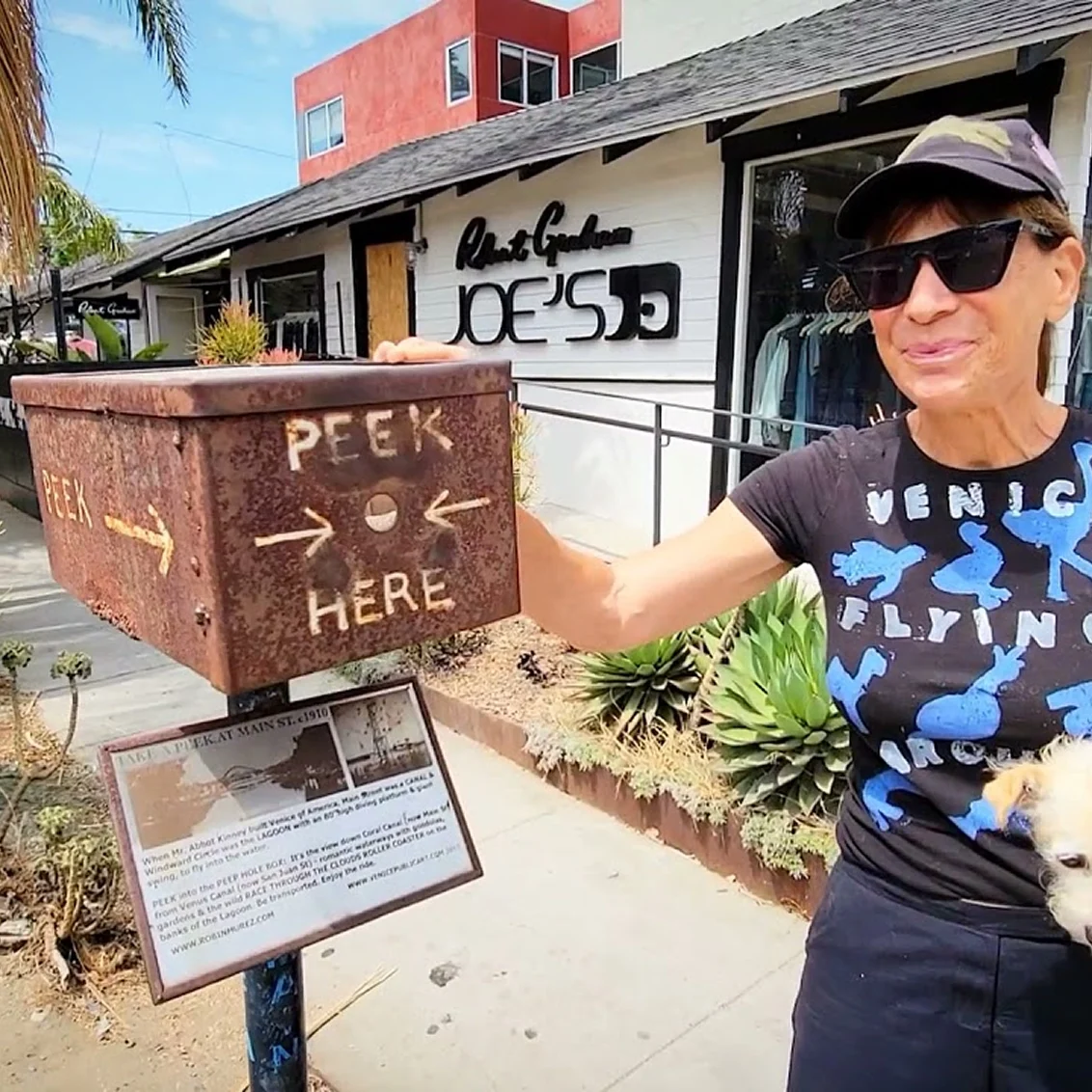
From her peephole box to her camel topiaries, local artist Robin Murez has spent the last ten years creating interactive and story-based works all over Venice. She greatly enjoys sharing Venice’s colorful history with the public and has even created a tour guide to all her art pieces, just a walk away from one another.
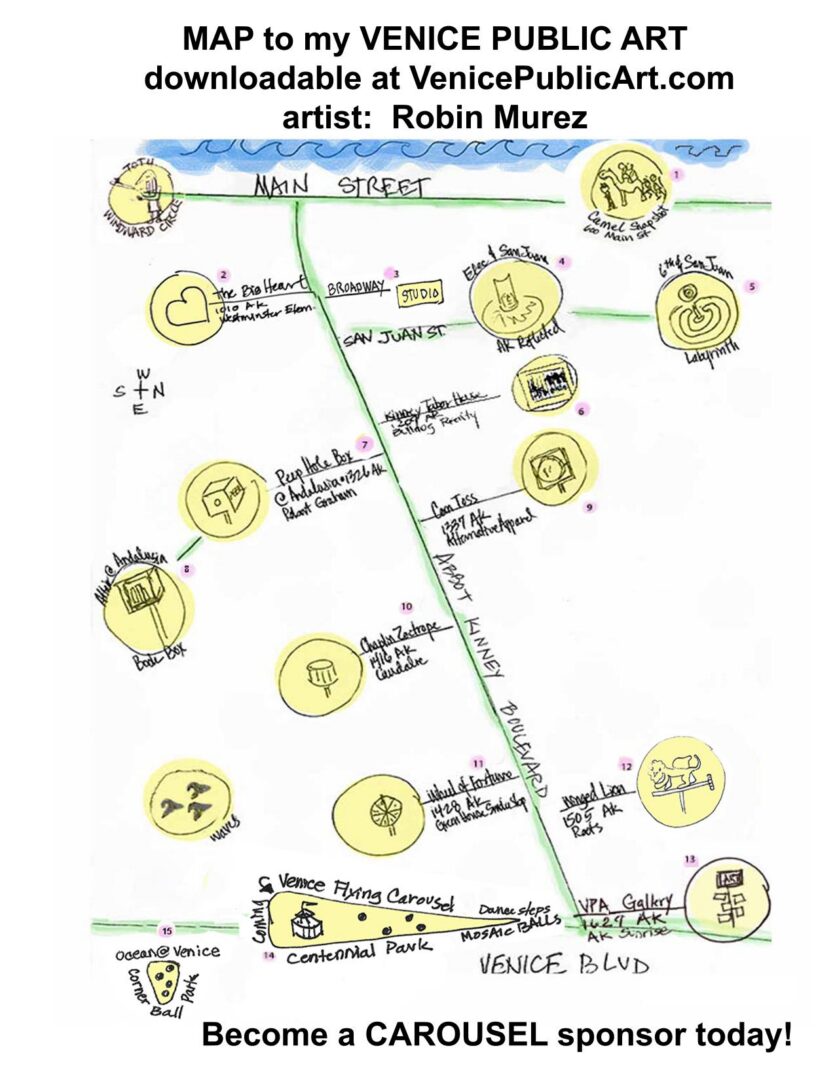
A guide to Robin Murez’s art around Venice. Courtesy: venicepublicart.com
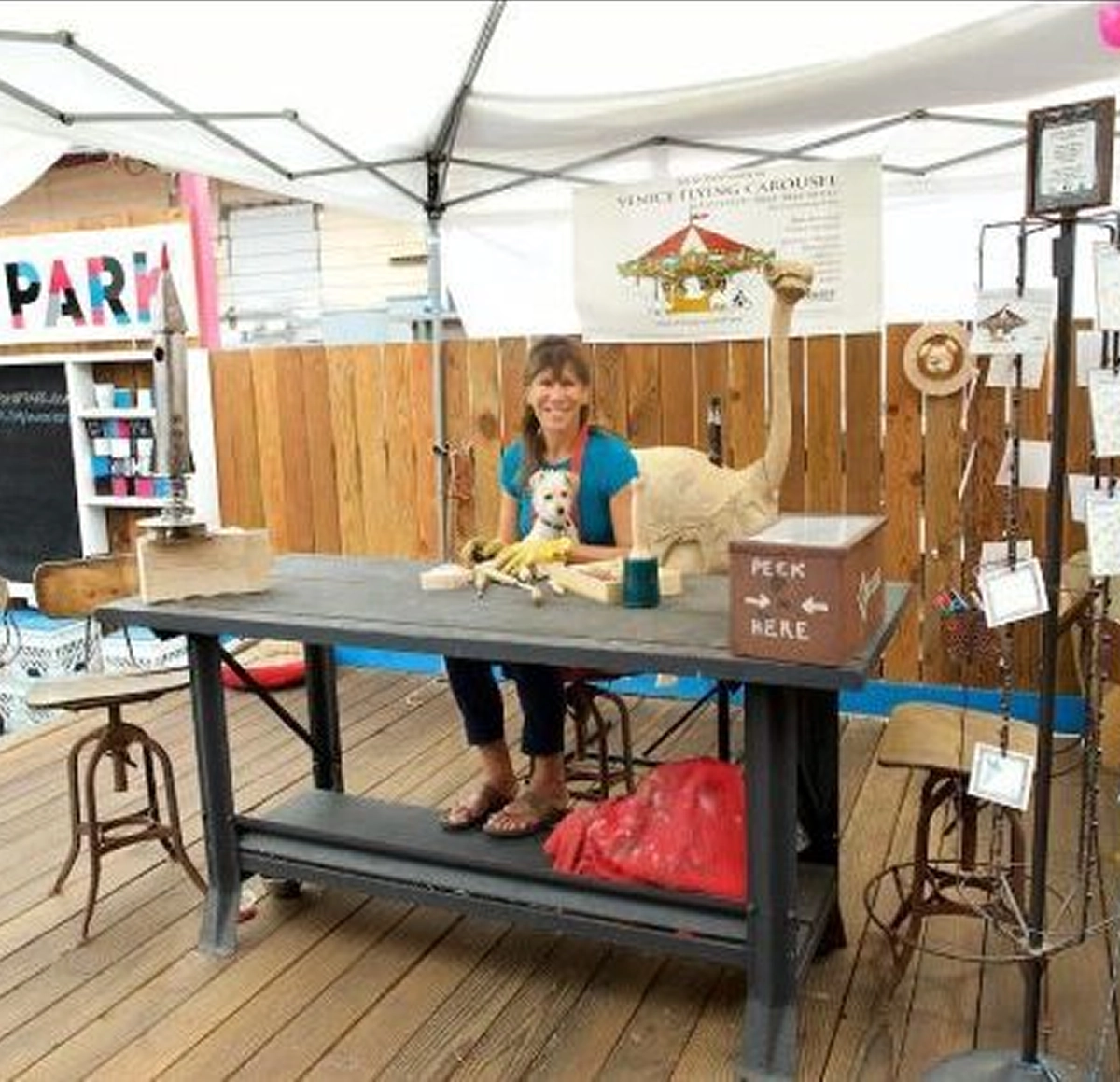
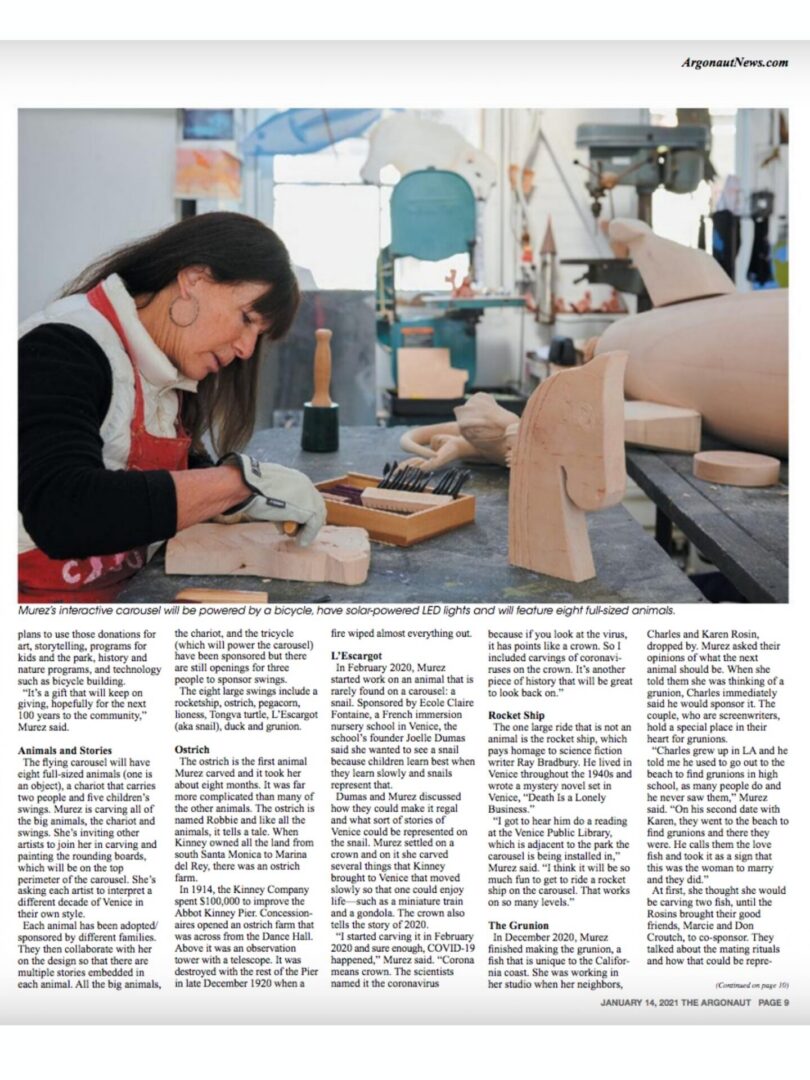
The Venice Place Project is sponsoring the Venice Flying Carousel by way of providing a workspace for Murez in its Pop-Up Park “where I carve and host carousel events,” Murez told Yo! Venice. The public space at 250 Broadway Ave., just off Abbot Kinney Blvd., is equipped with wi-fi, outlets, and tables. “I’ve always had a public studio. And I love the interaction with the public. Stop by to see me carving and join in on the project,” she said.
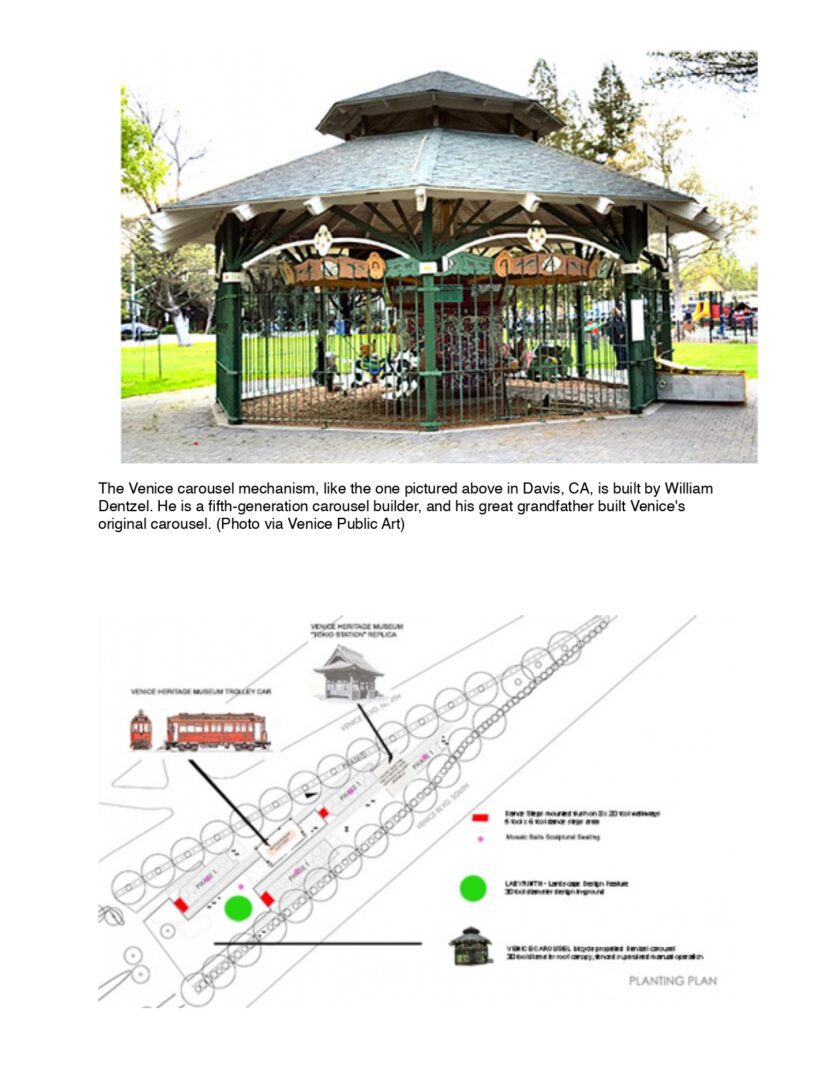
Using the Flying Carousel, Murez has devised a plan to turn Venice’s Centennial Park “into a place of joy and community.” Running from Abbot Kinney Blvd., to the Venice Public Library on an island sandwiched between Venice Blvd., North, and South, the park goes largely ignored and with the lack of benches and visitors, feels a bit unwelcoming. But, within proximity to the library, farmers markets, and Abbot Kinney, Murez believes the park has great potential with the carousel.
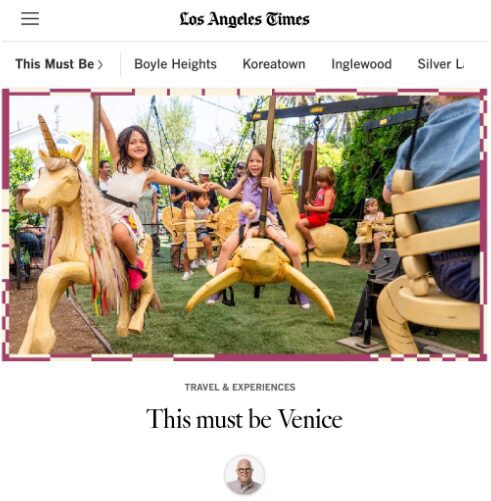
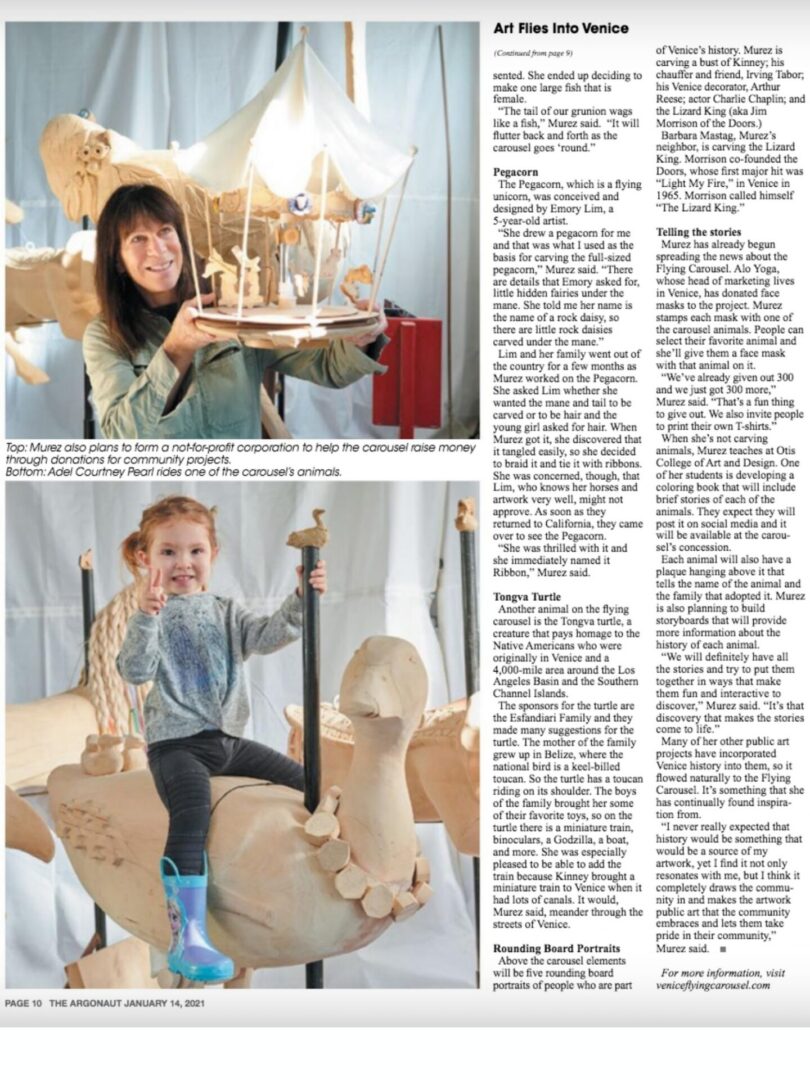
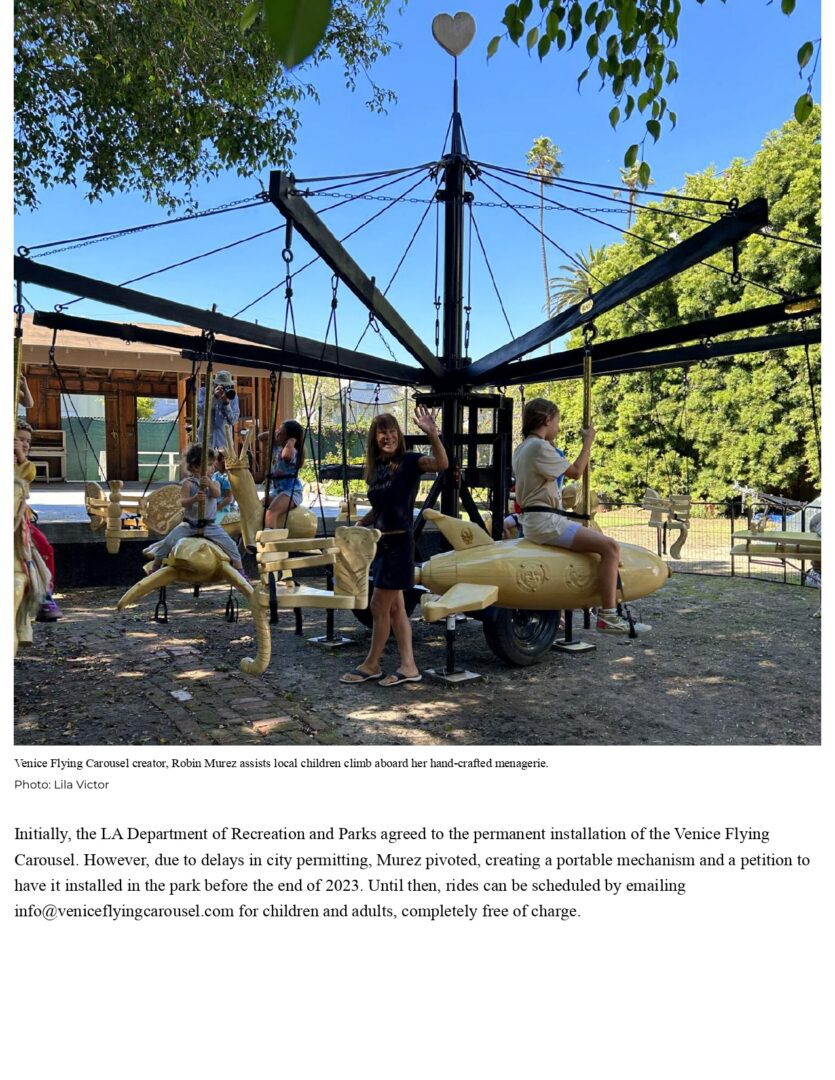
The proposed Flying Carousel will be 30-feet in diameter, holding 15 riders (yes adults, you’re welcome to ride too). Bike-powered and solar-lit, the carousel can be operated by a single person and run into the evenings. Total costs are estimated to reach about $200,000. Wrestling for grants and funding to cover construction, installation, permits, potential licensing fees, insurance, and the other hidden fees that are sure to come her way, Murez hopes to underwrite the rest of the balance with her Adopt-a-Carousel idea. A tradition in carousel building, a dozen people or so will have the opportunity to adopt a carousel animal of their choice or create one. Donors can help in the design and naming of the animal and have their own personal touch engraved into what will be Venice history.
The carousel has received widespread support. “Everyone I’ve told it to loves the idea,” Murez said. Projected to be finished by 2019, she is currently at the stage of carving the animals and working with the city and the Department of Recreation and Parks to commence construction.
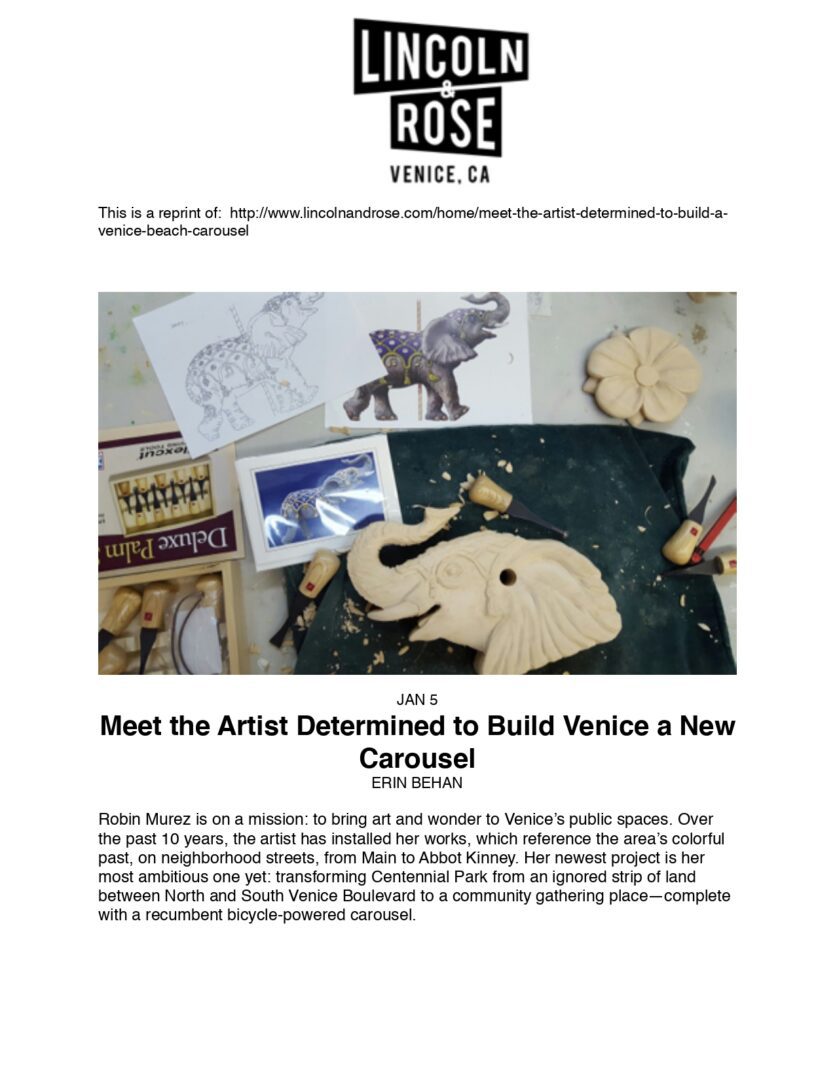
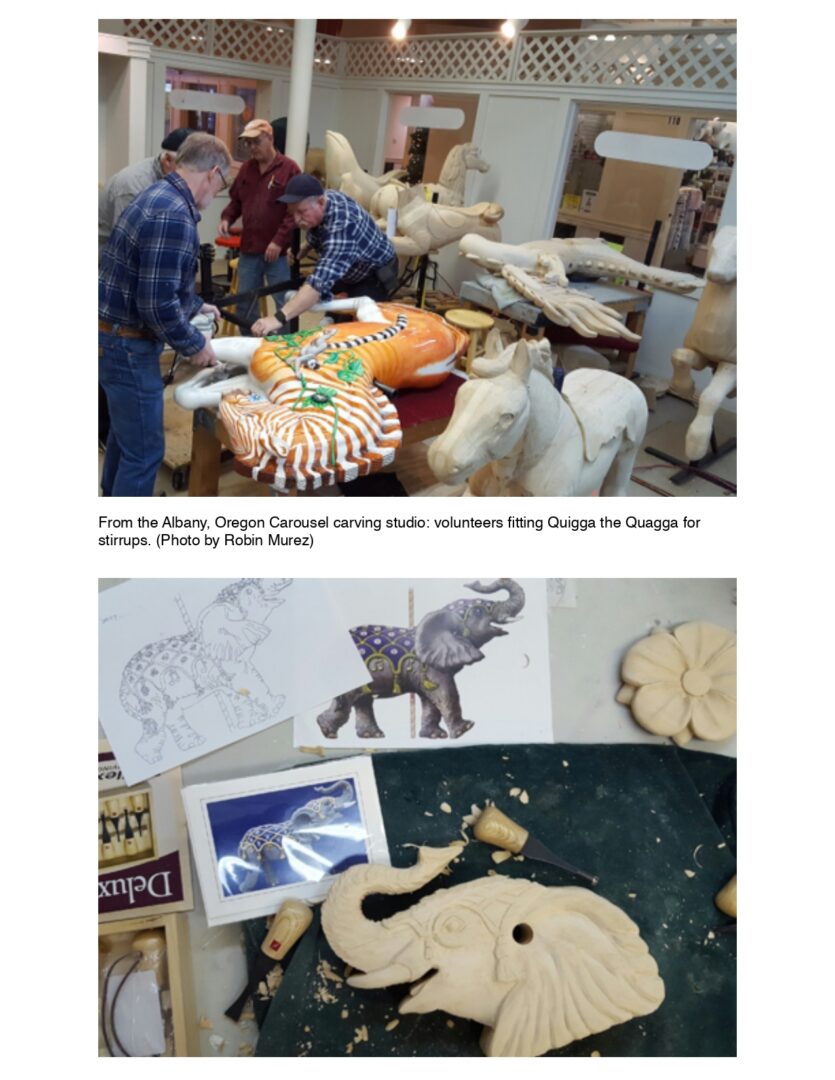
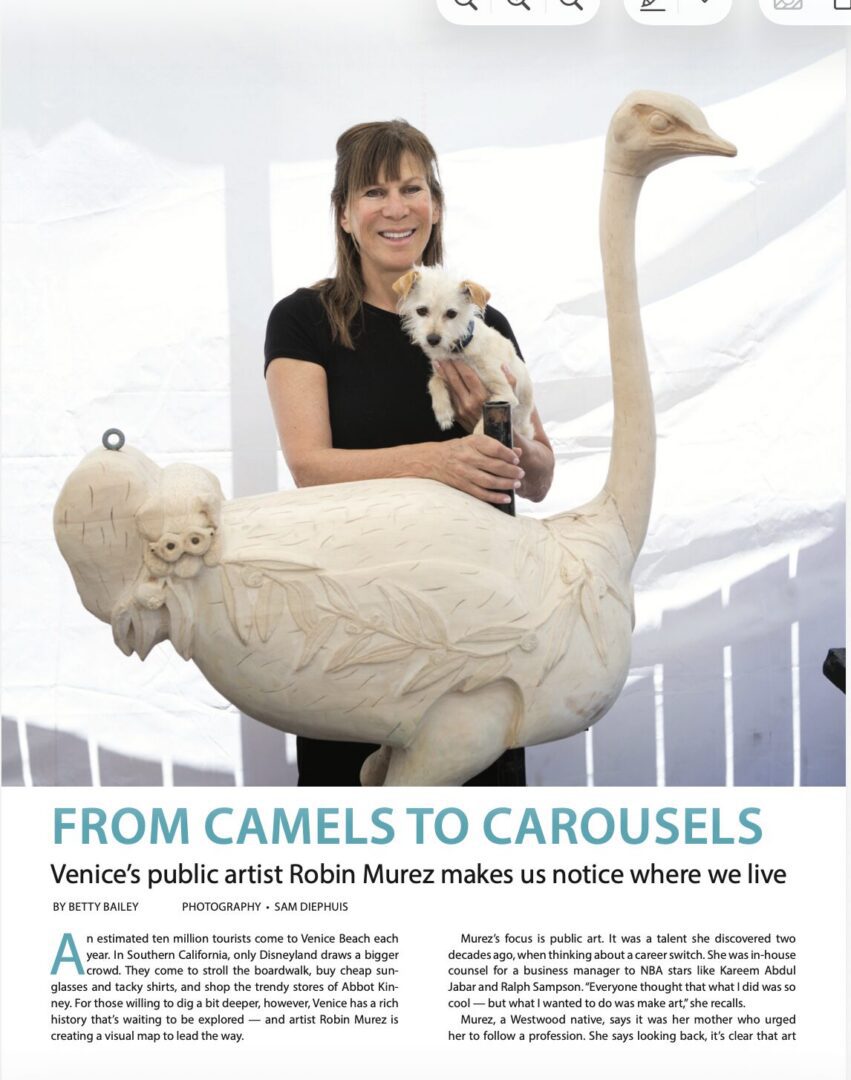
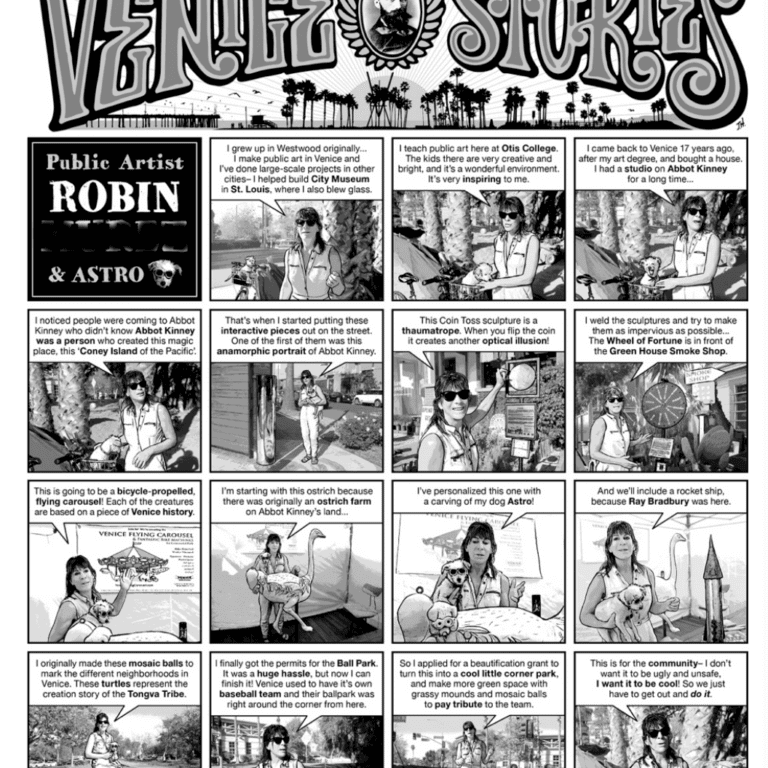
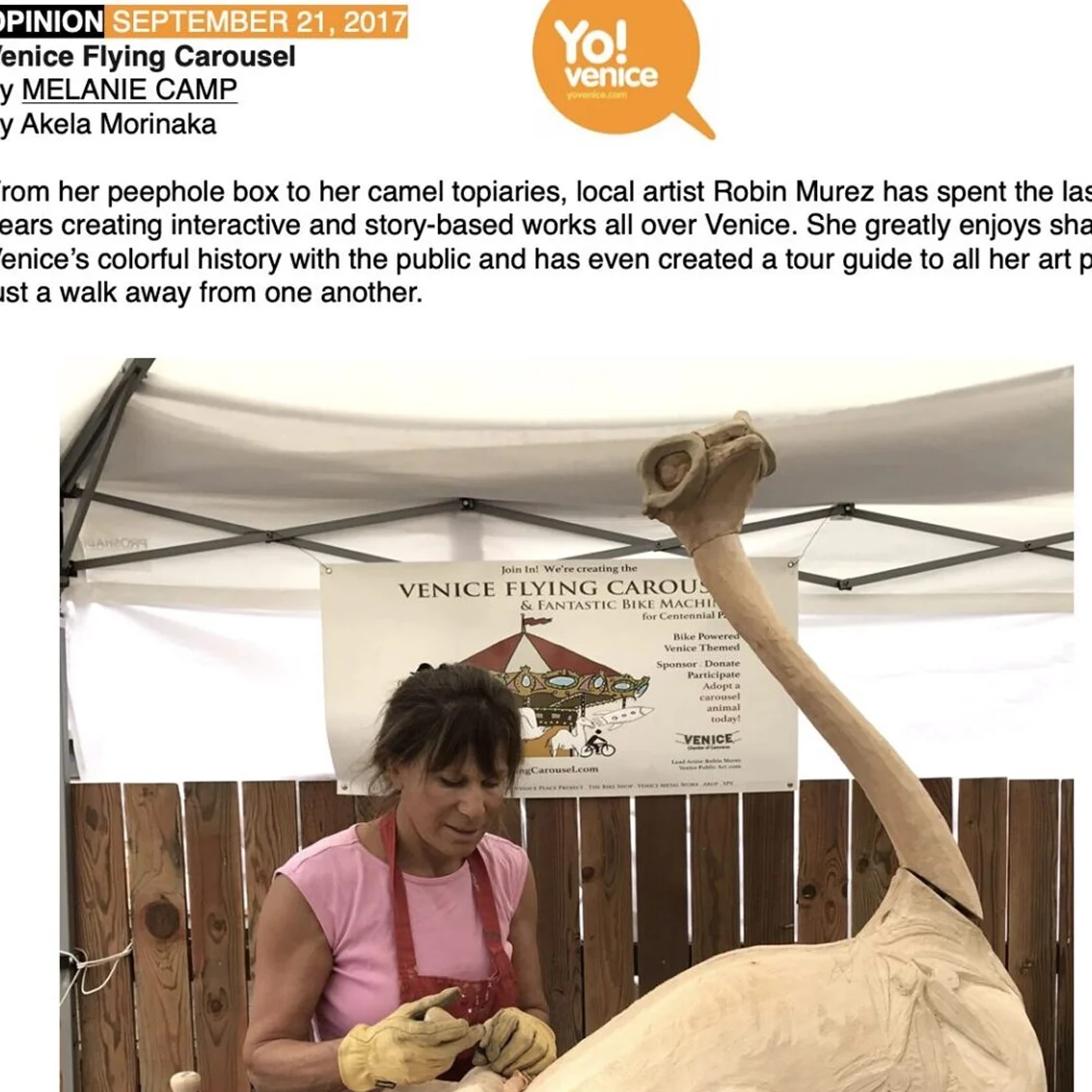
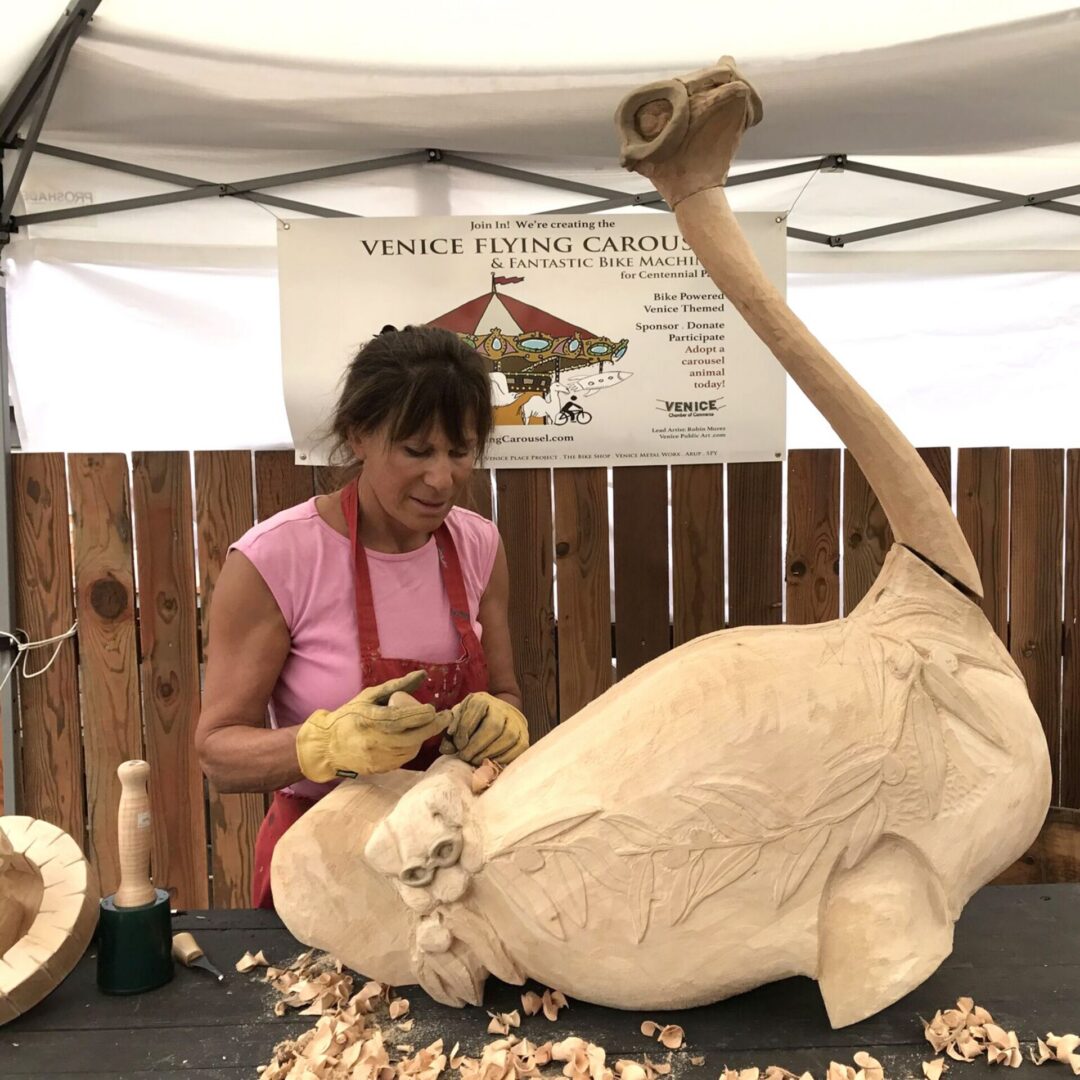
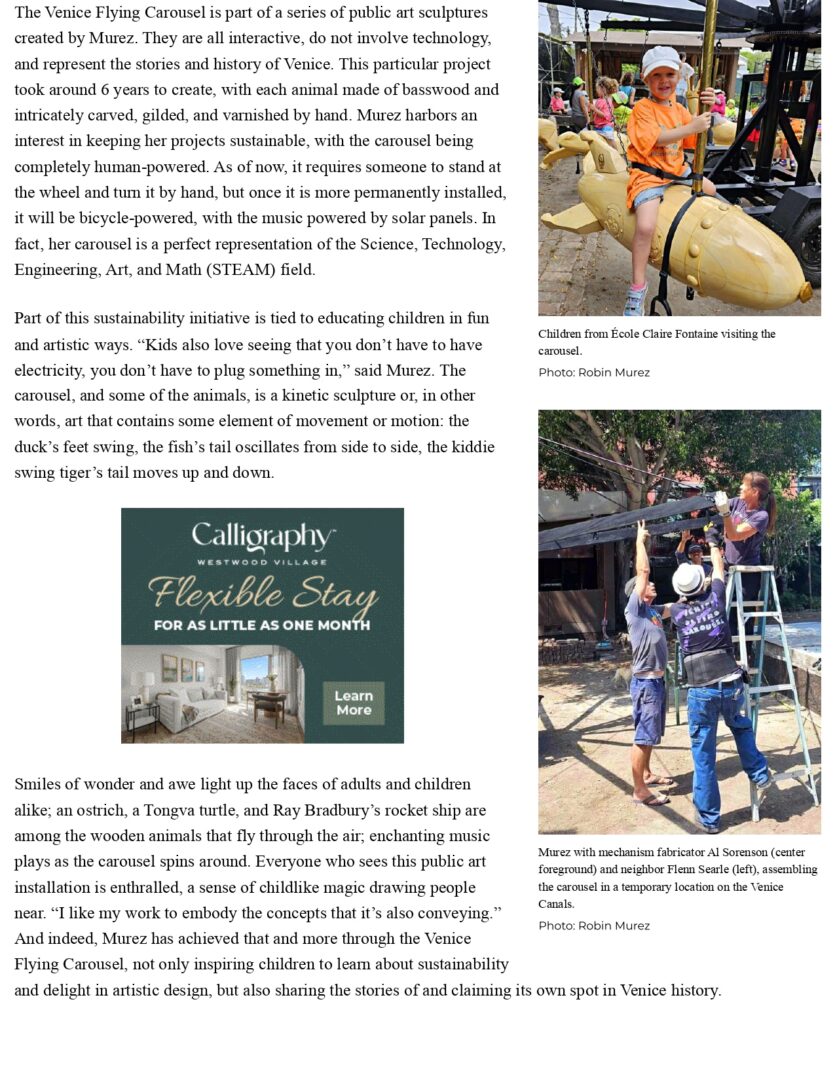
Taking influences from the Oregon Albany Carousel and The Davis Dentzel Carousel, Murez is determined to handcraft the sculptures. She started her first carving in April working on an ostrich laced with eucalyptus leaves on its side. During the establishment of Venice, Abbot Kinney commissioned ostrich farms on Windward Avenue, a lesser-known fact about Venice that she wants to share. And seated on the back of the ostrich is her dog, Astro, donned with goggles.
Abbot Kinney commissioned ostrich farms on Windward Avenue. This little-known fact inspired the first carousel animal. Photo by Alon Goldsmith.
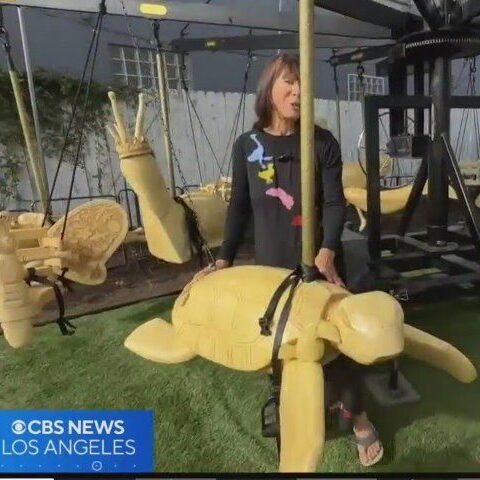
Some of Murez’ other carousel creature ideas include a turtle, symbolizing the Tongva tribe and creation of California, a rocket in honor of Ray Bradbury and science fiction, a guitar referencing Jim Morrison and the Doors, and a winged lion. The Winged Lion of Saint Mark is the symbol of Venice, Italy, where Abbot Kinney often found inspiration. Later, when building his Venice of America, he sculpted lions onto some of the Italian architecture archways and columns.
Murez has already begun involving the community. Safe Place for Youth (SPY) have helped with the landscaping and weeding of the park., and Murez has plans to engage the public at any point she can. When asked why she wanted to do this project she said, “The essence is really telling these stories, and having there be a sculptural element that brings out these stories. It will be this happy, beautiful, cool thing that brings out history and art and alternative technology.”
Donate, participate, and find out more at veniceflyingcarousel.com or venicepublicart.com and follow Yo! Venice for updates.
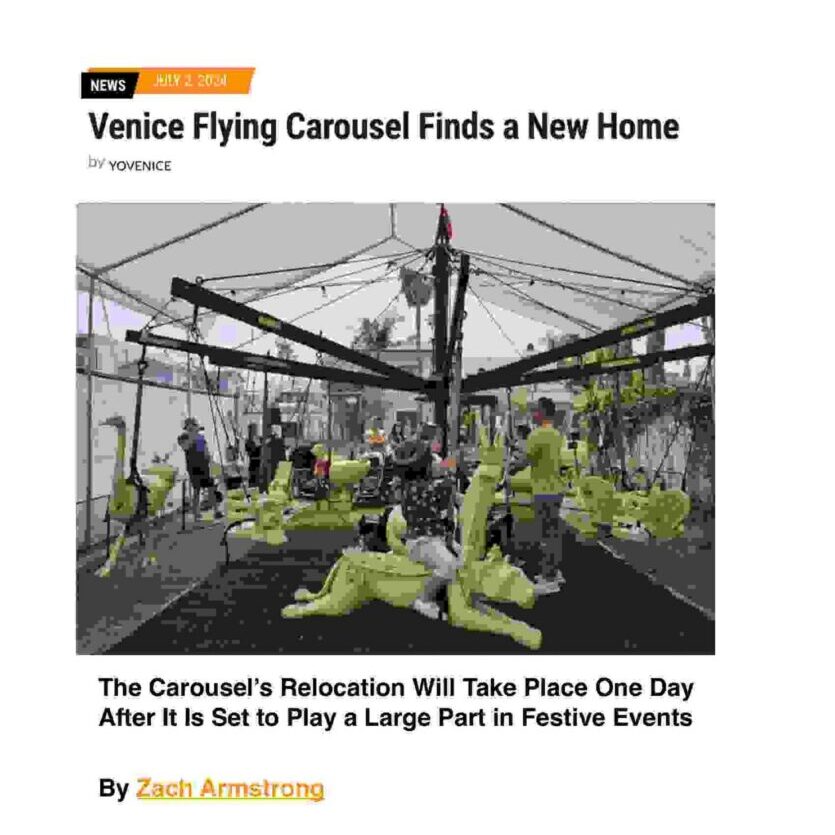
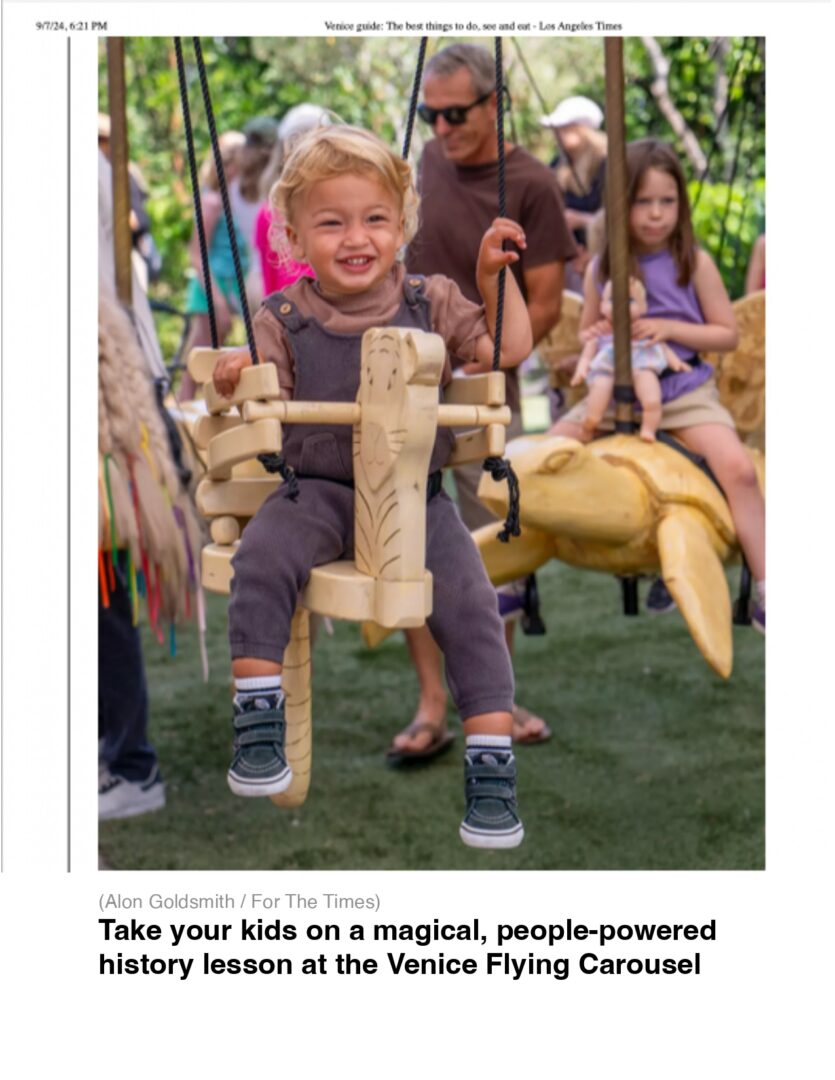
NEWS JULY 2, 2024 Venice Flying Carousel Finds a New Home
by YOVENICE
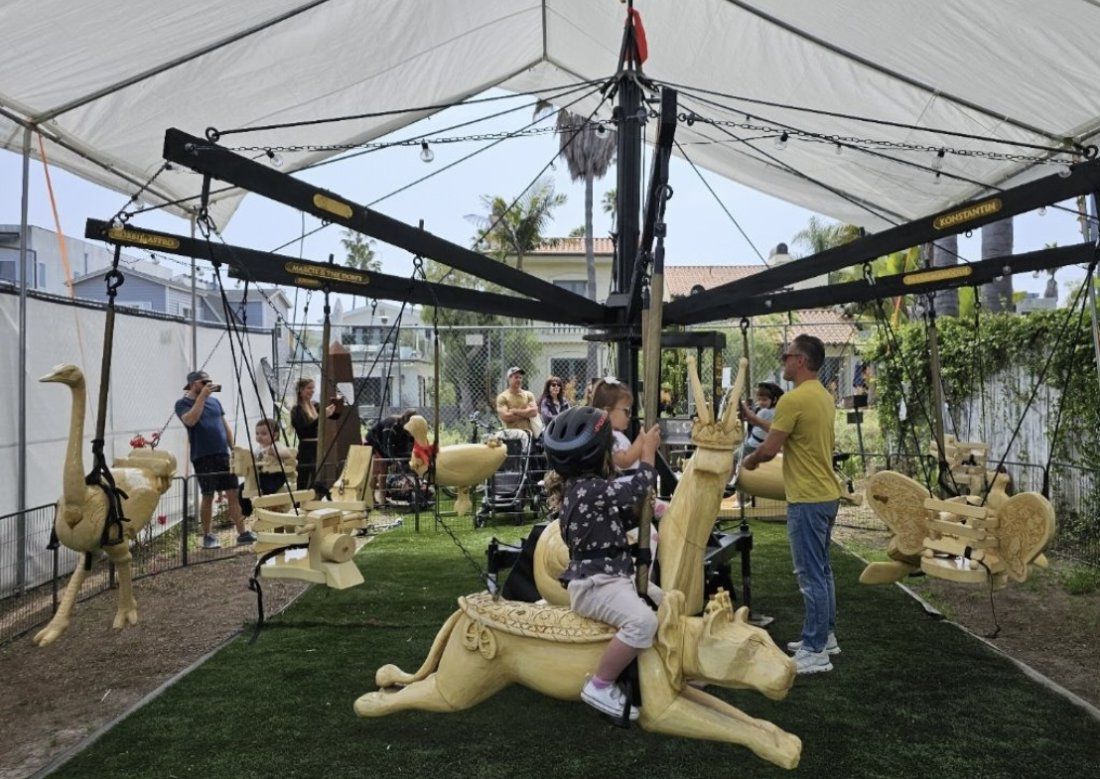
The Carousel’s Relocation Will Take Place One Day After It Is Set to Play a Large Part in Festive Events
By Zach Armstrong
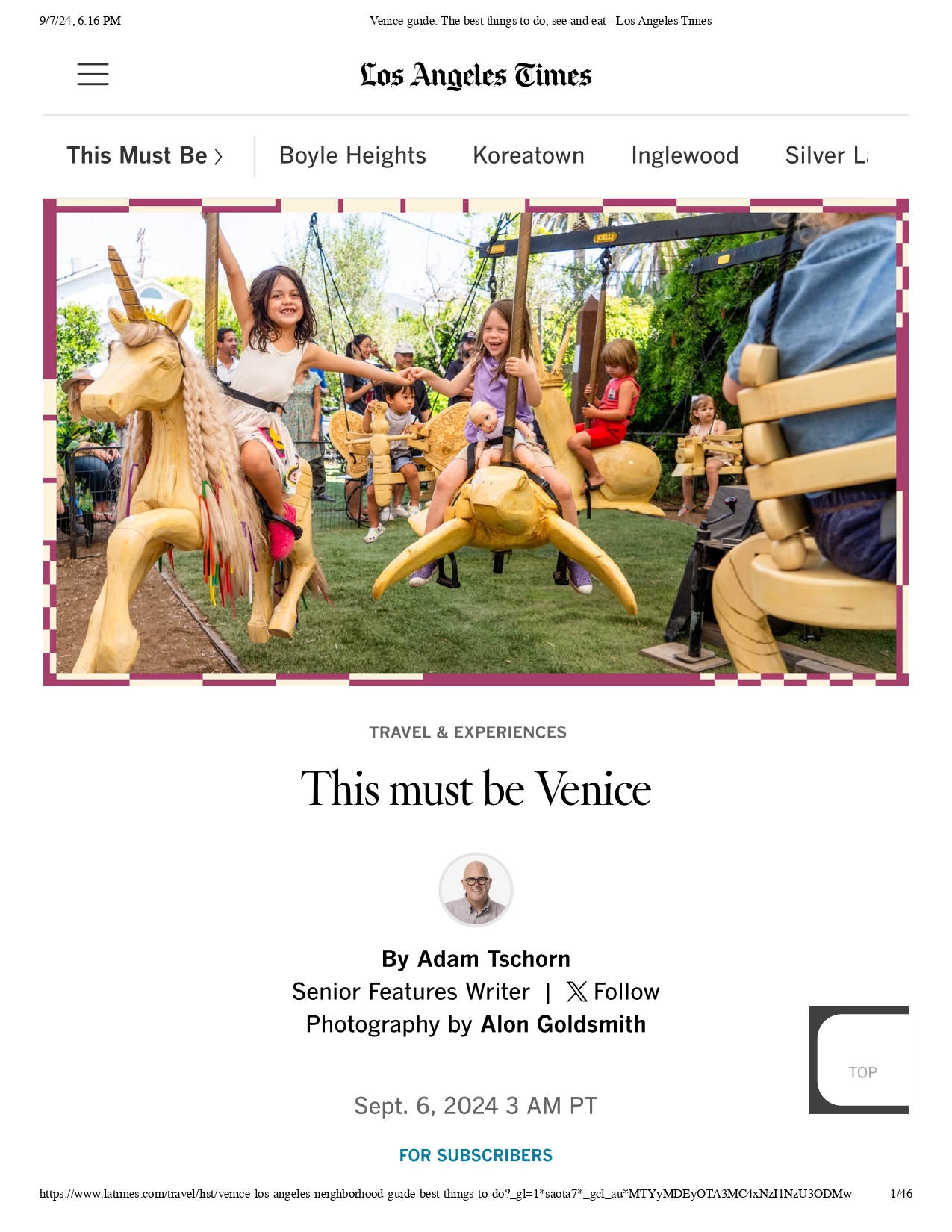
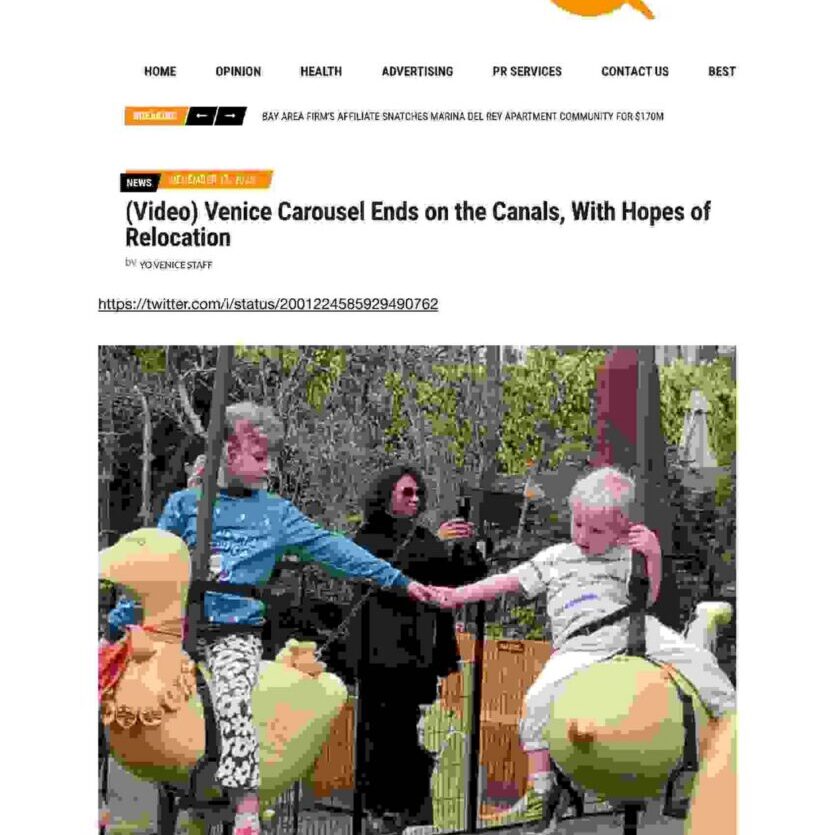
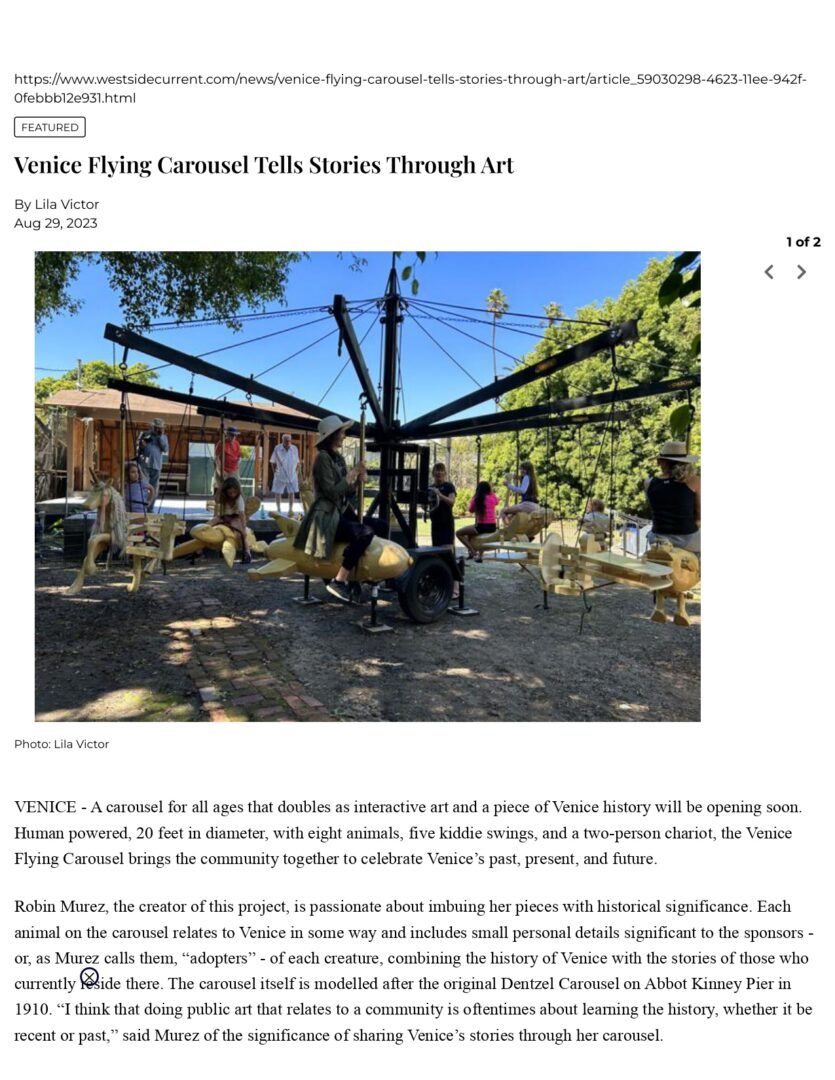
In the seven months since a non-electric and humanpowered carousel was installed next to the canals, one which tells the storied legacy of Venice Beach, thousands
of Angelinos have taken their children to the attraction for a ride. Now, the “Venice Flying Carousel” is finding a new home.
Whereas the carousel is currently situated at 419 Carroll Canal, it will be installed one canal over at 410 Linnie Canal following Fourth of July celebrations.
The attraction will be relocated July 5 to a parcel owned by long-time carousel supporters and sponsors Adam and Gia.
One day, Adam and Gia were taking a walk with their infant son, Asher, when they looked over and took an interest in the carvings of the carousel being done. They signed up to sponsor the project’s biplane ride and became members of the “carousel family.” The biplane ride of the carousel is an homage to “Thomas” Ince, a movie mogul who built the Ince AirField in Venice during the 1920s for barnstorming biplanes.
The carousel’s current spot was the site of a tragic fire that burned down a home along with a residence next door.
Following the blaze, the Alger family purchased the land and donated it to the carousel, while awaiting permits to
build their new home.
“The Alger family generously welcomed the Carousel onto their property; it has been wonderful!” describes Robin Murez, the artist of this community project.
As construction has begun for a new house on the adjacent parcel, the noise of tractors and billowing dust has disturbed the carousel’s serenity, making a new location preferable.
Luckily, Adam and Gia had one to offer. “We’re moving to ‘Asher’s Play Space’,” said Murez.
The carousel’s relocation will happen one day after playing a role in festive events along the canals.
On July 4, a series of Independence Day celebrations will take place nearby: a live band performance at Noon on Carroll at Eastern Canal, the Rubber Ducky Race at 1 p.m., the Downwind Regatta at 2 p.m and the inaugural Venice Preservationist Award will be given to historian and former rocket scientist Jeffrey Stanton. During these events, all families are invited for a ride on Murez’ handcarved attraction.
Eventually, the carousel will likely be stationed in Centennial Park under a pavilion; a much more visible location for the creative invention. Over 800 neighbors and locals have signed a petition for such a move, according to Murez.
https://www.westsidecurrent.com/lifestyle/legendary-women-artists-of-venice-awards-thursday/article_0ad94482-a2fb-Tlec-9618-9b16ebc42632.html
Legendary Women Artists of Venice Awards Thursday
Press Release
Mar 13, 2022
The Legendary Women Artists of Venice Award was established in 2018 in honor of Women’s History Month by the
Venice Art Crawl, Sunny Bak and Lauren Doyle.
The award recognizes the contribution of Women to the Arts and their profound impact on society. Venice Beach is a renowned artistic community; a haven for many famous artists, musicians, actors, and writers. Much of our historical identity centers around the arts – with homes to vibrant murals, museums, galleries, studios, and art resource centers. The Venice Art Crawl’s mission is to connect art and community, and to keep art moving at a time when it’s desperately needed.
People in the art world want to think we are achieving equity and inclusion more quickly than we are–Women face institutional obstacles with only 14% of living artists represented in galleries nationwide. Women are dramatically undervalued – between 2008 and 2019, more than $197 billion was spent on art at auction. Of that, work made by women accounted for just $4 billion–around 2 percent. Women earn 75% of bachelor of fine arts and master of fine arts degrees in the states, and yet only 46% of working artists are women.
Some of the most influential artists in history were female – painters like Georgia O’Keeffe and Frida Kahlo were instrumental in altering female prominence in the art world. The Legendary Women Artists of Venice Awardees shine light on the benefits of creative expression, collaborative initiatives, and creative workspaces. They uphold the legacy of feminist art history and theory across multiple art disciplines. Our Awardees meet the criteria of considerable accomplishment, achievement, and contribution to the Arts and Venice Beach community – with over 10+ years experience represented by their professional efforts, work, vision, and commitment.
VAC 2018 nominees Emily Winters, Judy Baca, Lucy Walker, Joelle Dumas, Jules Muck, Meryl Lebowitz, Jean Edelstein, and Christina Angelina were honored at the Erwin Hotel by Councilman Mike Bonin and George Francisco from the Venice Chamber of Commerce. Their work was recognized for its impact of and connections among the awardees themselves, and the effects made in the Venice neighborhood.
Awardee Emily Winters co-founded the Venice Arts Council and marked history as the first woman to be hired in the 60’s as a billboard painter by Gannett, a billboard company. Emily’s mural ‘Endangered Species’ was restored by fellow Awardee Judy Baca, Founder and Artistic Director of SPARC’s Mural Rescue team. Since the 1970’s, SPARC has been a catalyst for social change through the arts and a home for artistic innovation. Lucy Walker, Emmy Award Winner and Academy Awards Nominee is best known for her revolutionary vision and devotion to film. She organized Wild Thoughts #TEDxVeniceBeach with speakers Agnes Varda, Moby, and Diane von Furstenberg. Joelle Dumas, Founder of Ecole Claire Fontaine, focuses on the next generation of artists at her 32 year old Multilingual, Art, and Nature school for children ages 2-7. She works for the benefit of children with the Children’s Committee of the Venice Neighborhood Council and as Co-Founder of the Venice Chamber of Commerce Education Committee. Awardees Jules Muck and Christina Angelina’s dedication to mural artistry in Venice have touched and changed countless people in our community with their notorious, instantly recognizable murals – providing ‘Instagrammable’ moments for tourists and Venice locals, alike. Jean Edelstein is known for her dedication to painting, dance, music, and theatre with over sixty years of Leadership in innovative performance and compassionate political commentaries. Last but not least, Awardee Meryl Lebowitz documented Venice still-lifes and landscapes for more than 20 years–Her work can be seen in collections worldwide.
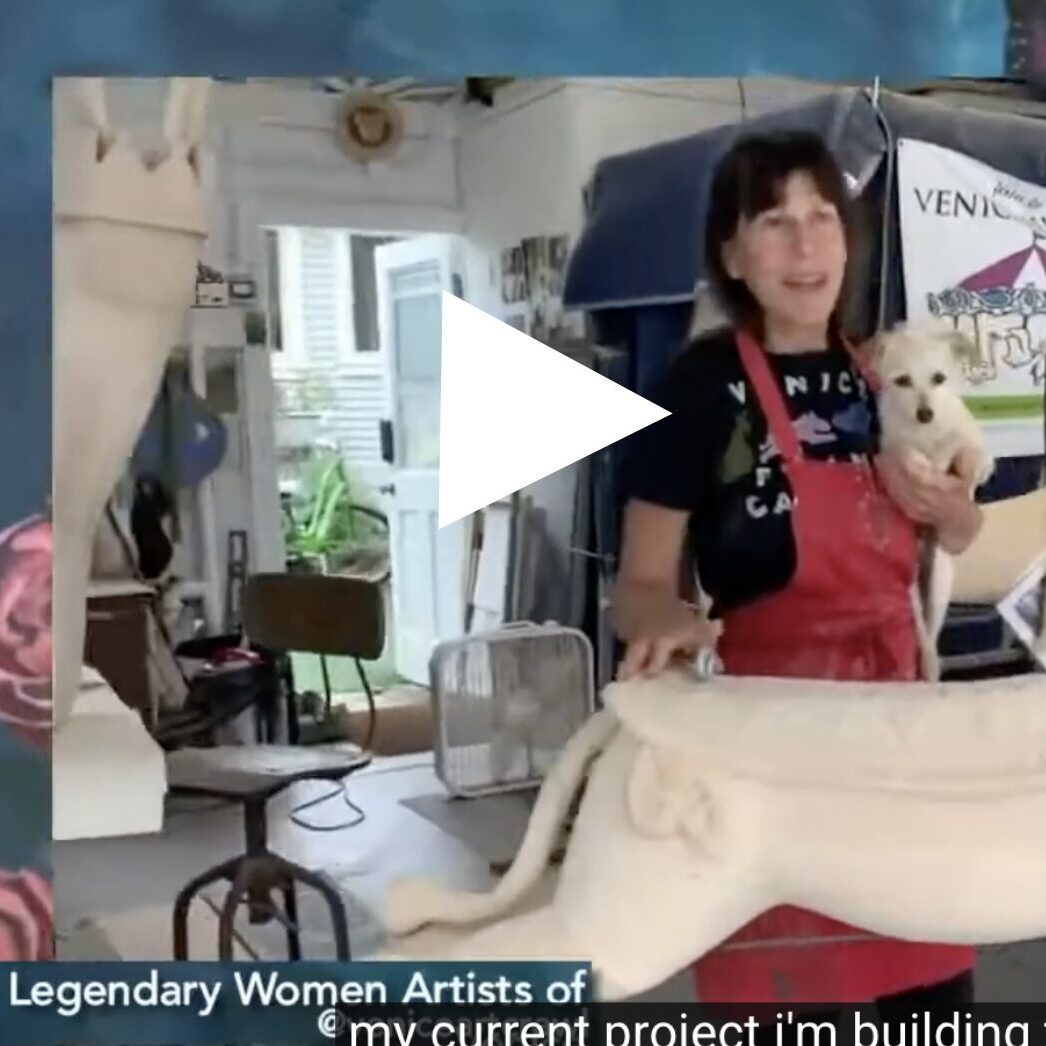
The 2020 Legendary Women Artists of Venice Awardees were Robin Murez and MB Boissonnault. Murez is a long-time resident of Venice and is passionate about public art. She is currently hand-carving a 20’ Carousel to be installed at the Abbot Kinney Memorial Library. Boissonnault studied abroad but landed in The States and has been living in Venice for nearly 20 years. She has shown extensively at the Cadillac Hotel, Beyond Baroque, The Pacific Design Center, and for VICA.
The Legendary Women Artists of Venice Award is presented semi-annually to female artists whose life and work exemplifies the Venice Art Crawl’s mission of creating community through art, education, and social activism. The award anticipates a lifetime of achievement for its recipients and the meeting of a new sisterhood in the arts.